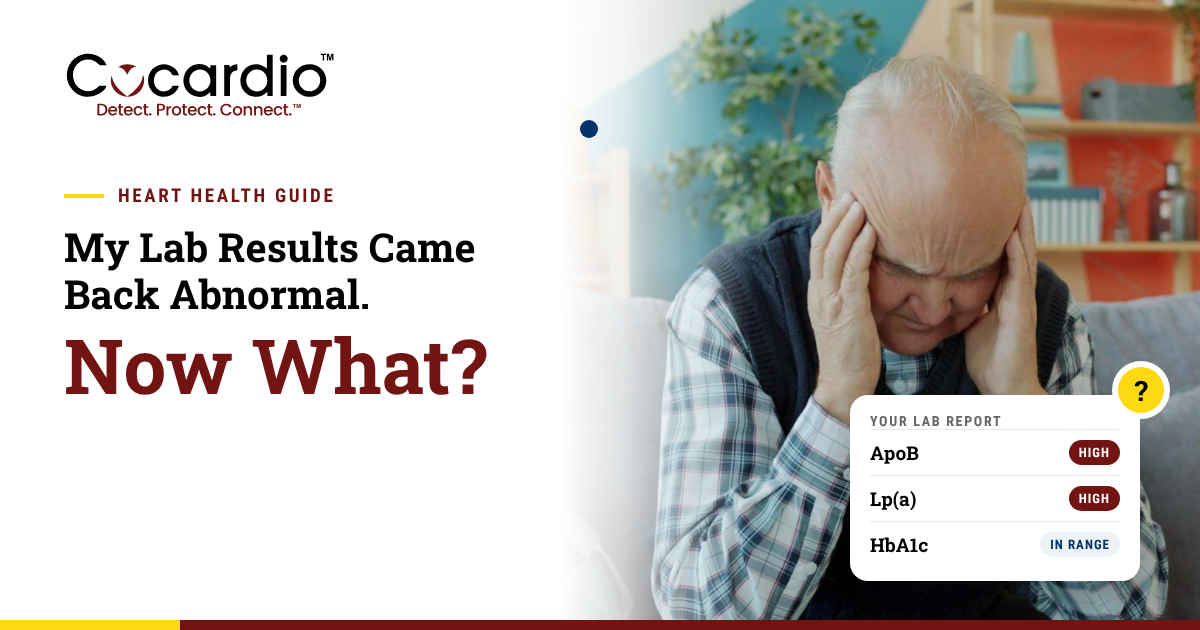
You paid for more information. What arrived was more questions.
Maybe you opened your results dashboard alone, at home, on your phone. Several markers were flagged. Your results may have arrived before anyone walked you through which ones mattered most.
If you are in your forties, fifties, or sixties, you may have ordered an advanced lab panel because you wanted a fuller picture of your health. Your results gave you more than you expected, and abnormal lab results can be unsettling to read on your own.
Here is the most useful thing to hold onto: you got the data. Now you need a plan.
Important: This article is educational and cannot interpret your results. New, worsening, or persistent chest discomfort needs prompt medical attention. Call 911 if you think you may be having an emergency.
How to Read Your Dashboard Correctly
Before looking at any single marker, it helps to understand what the dashboard is and is not telling you.
What a flag actually means. A flag means the result is outside the reference range. Nothing more. Reference ranges come from population data, not from you.
Why clinical context matters. A lab result means the most when it is read alongside your history, your family history, your blood pressure, your medications, and your life. Even with written notes on your report, many of those details sit with you and your own physician. That is why results from advanced heart testing should be interpreted in clinical context, not in fear.
Not everything flagged is cardiac. Some advanced lab panels test more than 100 biomarkers. Many people will have flags on vitamin D, ferritin, thyroid, or liver enzymes. This article covers the cardiovascular markers in your lab results. The rest belong with your physician, and being flagged does not rank something by importance.
Why several flags do not mean a heart attack is coming. A dashboard lists markers in rows. The body does not work in rows. Someone with insulin resistance may flag on glucose, triglycerides, hs-CRP, ApoB, and HDL at once. Read as five problems, that is frightening. Read as one underlying metabolic pattern, it is a single thing to work on, and much of it is modifiable.
These markers help us identify where we may be able to reduce risk.
What the Abnormal Result May Mean
The markers that deserve closer attention
ApoB. ApoB counts the particles that can lodge in an artery wall, rather than the cholesterol inside them. It usually moves with LDL and non-HDL. When they disagree, risk tends to track with ApoB. The 2026 ACC/AHA Multisociety Guideline on the Management of Dyslipidemia gives ApoB a defined role, particularly once LDL and non-HDL goals are met and with triglycerides above 200 mg/dL, in diabetes, or where LDL is already below 70 mg/dL. If you see ApoB high on your report, it is worth a closer look.
Lipoprotein(a). Lp(a) is largely inherited. It can be the hidden reason heart disease runs in a family. The 2026 guideline recommends measuring it at least once in every adult. A level of 125 nmol/L, or about 50 mg/dL, or higher is a risk-enhancing factor linked to roughly 1.4 times the long-term risk of heart attack or stroke. A level of 250 nmol/L, or about 100 mg/dL, or higher is linked to at least twice the long-term risk. With Lp(a) high, the rest of your cardiovascular risk assessment carries more weight.
hs-CRP. hs-CRP is an inflammation marker, and one of the most often misread markers on the panel. It rises with any inflammation, including a cold or an injury. The American Heart Association and CDC suggest two measurements about two weeks apart, taken when you are well and in a metabolically stable state. A result above 10 mg/L usually reflects acute illness, not cardiac risk, and warrants a retest. A single hs-CRP high reading is a reason to repeat it, not a verdict.
Glucose and HbA1c. Metabolic health sits upstream of much of the rest. Insulin resistance is linked to inflammation and endothelial dysfunction, the loss of healthy function in the lining of your blood vessels. That is why these markers so often flag alongside the lipid markers.
Cholesterol, read properly. LDL matters. Non-HDL, which is total cholesterol minus HDL, captures LDL plus VLDL plus IDL in one number and often predicts risk better. It is usually calculated from your standard lipid panel, so it needs no extra test.
How they interact, rather than as separate numbers
These markers are easier to understand as patterns. Three are common, and each points to a different conversation:
- The metabolic pattern: glucose, triglycerides, hs-CRP, and ApoB moving together.
- The inherited pattern: Lp(a) high, early family history, and everything else unremarkable.
- The mismatch pattern: LDL acceptable, ApoB elevated.
What It Does Not Necessarily Mean
- It does not mean you have heart disease.
- It does not mean a heart attack is coming.
- It does not mean you need medication.
- It does not mean you need every additional test available.
- It does not mean you did something wrong. Lp(a) in particular is inherited, not a lifestyle failure.
- A single reading of anything is a snapshot, not a trend.
The goal is to understand your complete cardiovascular picture.
Questions to Discuss With Your Physician
Take these to your next appointment:
- Which of these markers matters most in my specific case?
- Do any of these need repeating before we act on them?
- Do my results suggest one underlying pattern rather than several separate issues?
- Would a calcium score or other imaging change what we do next?
- What would you want to see change by my next set of labs?
- Is there anything here that explains my family history?
Evidence-Based Lifestyle Actions
Lifestyle, metabolic health, blood pressure, sleep, exercise, nutrition, and stress all shape your overall risk. Each is part of heart disease prevention.
Nutrition. Choose whole-food, plant-forward patterns. Saturated fat matters more than dietary cholesterol for most people. Soluble fiber is among the most effective dietary tools for lowering cholesterol, and it comes only from plants, in foods like oats, beans, lentils, and fruit. Reducing ultra-processed food is its own point: fewer packaged snacks, processed meats, and sugary drinks.
Exercise. Build cardiovascular fitness with regular activity such as brisk walking, cycling, or swimming. Add resistance training, which is often left out of heart advice and matters for insulin sensitivity. Check with your doctor before starting a new exercise routine.
Metabolic health. Visceral fat, the fat stored deep around your organs, is closely tied to insulin resistance. That is why your waist matters more than your scale weight.
Stress reduction. Ongoing stress raises blood pressure and disrupts sleep and blood sugar. Regular ways to unwind, such as time outdoors, movement, and time with people you care about, help bring it down.
Blood pressure. Blood pressure is one of the largest modifiable contributors to risk. Home readings give you and your physician a clearer picture than a single office visit.
Sleep. Sleep is under-discussed in cardiac care and genuinely consequential. Short or broken sleep raises blood pressure and makes blood sugar harder to manage.
Stress and autonomic health. Your autonomic nervous system controls heart rate and blood pressure without you thinking about it. Slow breathing and other calming practices may help shift it toward rest and recovery. Our article on the autonomic nervous system explains more.
Two honest notes. Lp(a) is largely genetic and will not move meaningfully with lifestyle, which matters so nobody blames themselves. And the 2026 guideline finds no proven role for dietary supplements in lowering cholesterol or triglycerides.
When Further Cardiovascular Assessment May Be Appropriate
Each of these may be discussed with your physician. None of them is something to go and order on your own.
Coronary artery calcium scoring. The 2026 guideline broadened its role to reclassify risk, pointing to men 40 and older and women 45 and older at borderline or intermediate risk, when the treatment decision is uncertain. A score of zero is reassuring: for some people, statin treatment may reasonably be deferred and the decision revisited later. A zero score does not rule out all plaque, and people with diabetes, who smoke, who have high Lp(a), or who have a strong family history may still benefit from treatment. A score above zero generally shifts the conversation toward earlier prevention.
Coronary CT angiography. This scan shows the arteries themselves rather than calcium alone, and it can reveal plaque a calcium score would miss. In the 2021 chest pain guideline, it carries a Class 1 recommendation (Level of Evidence A) for selected patients with chest pain. It uses contrast dye and radiation, so it is not a routine screening test for people without symptoms.
FFR-CT. This is software applied to a CCTA scan, estimating whether a narrowing actually restricts blood flow. The same guideline gives it a Class 2a recommendation for patients with chest pain whose CCTA shows a narrowing between 40 and 90 percent.
Repeat testing. Sometimes the right next step is not a new test but the same one again, done properly. hs-CRP is the clearest example. Repeating a test is part of a careful cardiovascular risk assessment, and part of using advanced heart testing well.
How CoCardio® Can Help
Detect Early. Protect Fully. Connect Deeply.
You have the data, and a short appointment rarely leaves room to work through what it means for your daily life. That longer conversation is what the Root Cause Consultation is for. It is preventive cardiology focused on you: your results, your history, and your plan, reviewed with you by Dr Pratiksha G Gandhi MD, Preventive Heartcare Expert. You got the data. Now you need a plan.
Medication is one tool. The bigger opportunity is understanding your actual cardiovascular risk and building a comprehensive prevention plan around it. This article is not anti-statin and not anti-medication. Medication may be one part of the strategy. Lifestyle and metabolic optimization remain important regardless.
CoCardio® works alongside your existing medical care, never instead of it, and never advises starting, stopping, or changing prescribed medication. Medication decisions stay with the physician who prescribed it.
Already have your advanced labs? Book a Root Cause Consultation at our Encinitas, California clinic, and Dr Gandhi will go through your results with you and help you build a personalized prevention plan. Please share results only through our secure booking and intake process, never by email, social media, or public comments.
Frequently Asked Questions
Does an abnormal lab result mean I have heart disease?
Not on its own. A flag means a result is outside the reference range. It is a reason to look closer with your physician, not a diagnosis.
Should I repeat any of these tests before acting on them?
It depends. hs-CRP in particular calls for two measurements about two weeks apart. Your physician can tell you which other results are worth repeating.
Can I lower my Lp(a) with diet and exercise?
No, not meaningfully. It is largely genetic. Diet and exercise still matter for the rest of your risk.
Do I need a calcium score?
It depends on your age, your risk estimate, and your physician’s judgment.
My LDL is fine, but my ApoB is high. Which do I trust?
It depends, and this is worth raising with your doctor. When they disagree, risk tends to track with ApoB.
Do supplements fix these numbers?
No. The 2026 guideline finds no proven role for dietary supplements in lowering cholesterol or triglycerides.
Medical Disclaimer
This article is provided for general educational purposes and does not constitute medical advice, diagnosis, or treatment. Individual circumstances vary, and decisions regarding cardiovascular care should be made with appropriate healthcare professionals.
CoCardio® services are designed to complement, not replace, emergency care, a cardiologist, primary care physician, cardiac rehabilitation program, prescribed medication, diagnostic testing, or medically recommended procedures.
If you have new, severe, or worsening symptoms, seek appropriate medical attention rather than relying on information provided in this article.
Sources
Blumenthal RS, et al. 2026 ACC/AHA/AACVPR/ABC/ACPM/ADA/AGS/APhA/ASPC/NLA/PCNA Guideline on the Management of Dyslipidemia. Circulation. Published online March 13, 2026. doi:10.1161/CIR.0000000000001423
Gulati M, Levy PD, Mukherjee D, et al. 2021 AHA/ACC/ASE/CHEST/SAEM/SCCT/SCMR Guideline for the Evaluation and Diagnosis of Chest Pain. Circulation. 2021;144:e368-e454. doi:10.1161/CIR.0000000000001029
Pearson TA, Mensah GA, Alexander RW, et al. Markers of Inflammation and Cardiovascular Disease: Application to Clinical and Public Health Practice. A Statement for Healthcare Professionals From the CDC and the AHA. Circulation. 2003;107:499-511. doi:10.1161/01.CIR.0000052939.59093.45