The Number on Your Wrist That Nobody Explains
Your watch gives you a heart rate variability (HRV) score. Maybe it is 38 one morning and 51 the next. Maybe it dropped after a bad night and you have been quietly worried about it since.
What almost nobody tells you is what that number actually means, how much weight to put on it, or whether a low reading is something to act on.
Heart rate variability has become one of the most talked about and least explained numbers in personal health. The link between HRV and heart health is genuinely interesting, and there is real science behind it.
This article separates the two. What HRV measures. What affects it. What the evidence supports. And where the claims run ahead of the research, which they often do.
Important: This article is for educational purposes and cannot interpret your readings or assess your health. New, worsening, or persistent chest discomfort, especially discomfort at rest, may need emergency medical attention. Call 911 if you think you may be having a medical emergency.
Quick Answer
What can heart rate variability (HRV) tell you, and what can it not?
It depends on what you are asking it for.
Here is what heart rate variability can tell you. HRV measures the small changes in time between one heartbeat and the next. Those gaps are shaped by your autonomic nervous system, so HRV gives one window into how that system is behaving. Tracked over weeks, your own trend can reflect things like sleep, stress, illness, alcohol, and training load.
Here is what HRV cannot tell you. It is not a diagnosis. It does not tell you how healthy your heart is. Your number cannot be meaningfully compared against another person’s, because normal ranges vary widely between individuals. And the standard-setting guidance on HRV notes that its established clinical uses are fairly narrow, and that how you measure it matters a great deal.[1]
So HRV is best treated as one interesting signal among many, and as a conversation starter with a healthcare professional rather than an answer.
Research has also examined whether ECP/EECP® therapy affects HRV, with some studies reporting increased vagal activity. That work is early, and we describe it below as exactly that.
What Heart Rate Variability (HRV) Actually Measures
Your heart does not beat like a metronome. Even at a steady rate, the gap between beats changes slightly from one to the next.
That variation is heart rate variability. The heart rate variability meaning is that simple: it is the variation in timing from one beat to the next.
It happens because your heart is constantly receiving signals from your autonomic nervous system. HRV is a window into that system, the automatic control system that manages things you never think about. That system has two branches. One speeds things up for effort and stress. The other slows things down for rest and recovery. The push and pull between them shows up in those tiny timing differences.
Generally speaking, more variation is associated with a body that shifts easily between those states. Less variation is associated with a body under strain, whether from stress, illness, poor sleep, or hard training.
Those two words, “generally speaking,” matter here. This is a pattern, not a rule.
What Affects Your Heart Rate Variability
The honest list is long, and that is part of the point.
Heart rate variability can be influenced by sleep quality and duration, stress, alcohol, illness, hydration, training load and recovery, time of day, breathing, medications, age, and underlying health conditions.
That breadth explains something people find frustrating. A single low reading rarely means anything on its own. You had a glass of wine, slept badly, or are fighting something off. The number moved. That is HRV working as expected, not a warning.
This is why people who use HRV well look at trends over weeks, not at any single morning.
What Is a Good Heart Rate Variability (HRV) Score?
This is the most searched question about HRV, and the honest answer disappoints people.
There is no universal good score.
Heart rate variability varies enormously between individuals. It generally declines with age. It differs by measurement method, by device, by time of day, and by body position. A number that is unremarkable for one person could be high or low for another.
Comparing your HRV to a friend’s, or to an online average, tells you very little. Comparing your HRV to your own baseline over time tells you more.
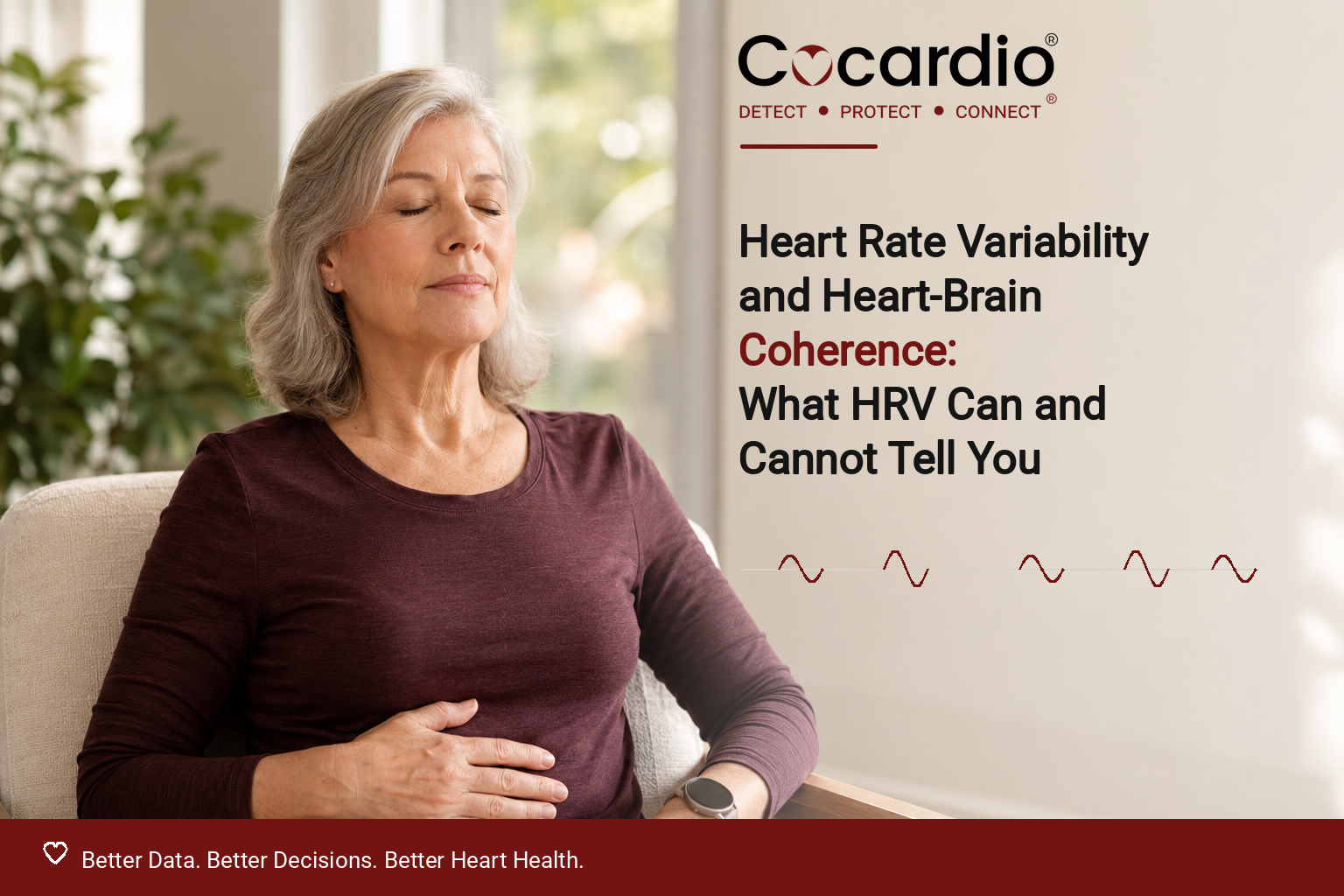
About “Heart-Brain Coherence”
You may encounter the term heart-brain coherence, particularly in wellness settings. It usually refers to a state, often produced through slow paced breathing, in which heart rhythm patterns become more regular and wave-like.
Here is a fair assessment.
The underlying physiology is real. Slow, paced breathing does measurably influence heart rhythm patterns, through a well-described relationship between breathing and heart rate. Breathing practices have been studied in relation to stress and relaxation.
But the broader claims attached to the term coherence, particularly claims about specific health outcomes, go well beyond what has been established. This is an area where popular framing has run ahead of the evidence.
Our position is straightforward. Slow breathing practices are low-risk and many people find them useful. That is a reasonable basis for trying them. It is not a basis for claiming they treat any condition, and we do not make that claim.
Heart Rate Variability Smartwatch Accuracy: Should You Trust Your Device?
It depends, and the caveats matter.
HRV smartwatch accuracy varies. Consumer devices differ in how they measure HRV, when they measure it, and how they present the result. Some measure overnight. Some take spot readings. Some report raw values, others report proprietary scores that are not comparable across brands.
Guidance on HRV measurement emphasizes that methodology matters, and that results depend heavily on how and under what conditions the measurement is taken.[1]
The practical takeaway: your device is probably reasonable for tracking your own trend under consistent conditions. It is not a clinical instrument, and its number should not be compared with anyone else’s.
What Heart Rate Variability Can Tell You, and What It Cannot
Worth stating plainly.
It cannot diagnose anything. Not a heart condition, not autonomic dysfunction, not anything else. Diagnosis belongs with qualified medical professionals.
It cannot override your symptoms. If you have concerning symptoms, a reassuring HRV number changes nothing. Seek medical care.
It cannot rank your heart health. A high HRV is not a clean bill of health, and a low one is not a diagnosis.
It cannot be compared between people. That is worth saying twice, because so much online content does exactly that.
Has ECP/EECP® Therapy Been Studied in Relation to Heart Rate Variability?
Yes, and this is a genuine area of research rather than a marketing claim. It is also a small evidence base, and worth describing accurately.
The direct study. Michaels and colleagues examined the effects of enhanced external counterpulsation on both time-domain and frequency-domain measures of heart rate variability, published in the Journal of Electrocardiology in 2007.[2] This is the study specifically designed around the question.
In heart failure patients. A 2025 study in Cardiovascular Toxicology looked at cardiac rehabilitation combined with EECP in 120 patients with chronic heart failure. The combined group showed higher SDNN, SDANN, rMSSD, and pNN50, along with a lower LF/HF ratio.[3] In plain terms, several standard HRV measures improved, and the balance between the two branches of the autonomic nervous system shifted.
In ischemic stroke patients. Xiong and colleagues monitored beat-to-beat heart rate before, during, and after ECP in 48 patients with unilateral ischemic stroke, alongside 14 healthy controls. Their conclusion: irrespective of which side the ischemia was on, patients showed increased beat-to-beat HRV after ECP.[4] Total power increased significantly after treatment in both left-sided and right-sided stroke patients.[4]
In healthy adults. A randomized, sham-controlled study of 40 healthy adults measured EEG and ECG signals before, during, and after EECP, including frequency-domain HRV. The researchers found changes in a measure of brain-heart coupling, and suggested it may be a marker of how a person responds to EECP.[5] Notably, those changes were not associated with the physiological and hemodynamic measures analyzed, which is a reminder that the mechanism is not settled.[5]
One Person’s Experience
A naturopathic physician we will call Dr. K. came to CoCardio® with a problem he could not solve on his own.
He had managed high blood pressure since he was young. He exercised intensely. His lifestyle was, by his own account, already good. But after COVID his HRV had flattened and would not move, no matter what he did. For someone who tracks his own health data closely, that was frustrating in a specific way: he could see the number, and he could not shift it.
He began a course of ECP therapy as part of a broader plan.
Those are his reported measurements and his reported experience. They are not a predicted outcome for anyone else, and no provider can promise a specific change in your numbers. What his story does illustrate is why the research above is worth following, and why measuring before and after matters more than measuring once.
What This Does and Does Not Mean
The honest summary: research has examined ECP and HRV in several populations, and some studies report increased vagal activity following a course of treatment.
But these are small studies, conducted in specific groups such as heart failure and stroke patients, and not all findings point the same direction. This is an active research question, not an established outcome.
So we describe it as what it is. ECP and HRV is a studied relationship worth following. It is not a promise that your HRV will change, and CoCardio® does not present HRV as a measure of whether our services are working.
How CoCardio® Approaches Heart Rate Variability
At CoCardio®, we do not begin with a treatment. We begin by understanding you.
Every care journey starts with a consultation. Our team reviews your health history, your current medical care, your prior testing, your goals, and the safety considerations relevant to you. If you track HRV and want to bring that data, we are happy to look at it in context. The consultation is not an unnecessary step. It is how we understand the person behind the numbers and decide the most appropriate next step. It also helps us see when coordination with your existing healthcare professionals may be appropriate.
The daily factors that influence HRV are also the ones that matter for cardiovascular wellness generally: sleep, stress, activity, nutrition, and recovery. Our coaching program, offered one-on-one or in a group, teaches practices intended to support vagal tone. Following appropriate evaluation, work in those areas may be organized through the Healthy Heart Blueprint™. It is a personalized roadmap designed to help you better understand your cardiovascular wellness goals, current health considerations, and possible next steps.
We want to be clear about the boundary. CoCardio® does not diagnose or treat conditions based on HRV, and we do not present HRV as a measure of whether our services are working. Interpreting health data belongs with qualified medical professionals. CoCardio® never advises anyone to start, stop, or change prescribed medication. Our role is professional education and support alongside the care you already receive.
Cost and Payment
CoCardio® is a cash-pay practice. We do not bill insurance for consultations, ECP sessions, or preventive cardiovascular wellness services. Eligible HSA and FSA payments may be accepted. Please confirm eligibility with your plan administrator.
Frequently Asked Questions
What is a good heart rate variability score?
It depends on the person. There is no universal target. HRV varies widely between individuals, generally declines with age, and differs by device and measurement method. Your own trend over time is more useful than any absolute number.
Does low heart rate variability mean something is wrong with my heart?
No. A single low reading commonly reflects poor sleep, stress, alcohol, or illness. HRV is not a diagnostic test, and it cannot tell you whether you have a heart condition. If you have symptoms or concerns, speak with a healthcare professional.
Can breathing exercises improve my HRV?
It depends. Slow, paced breathing does measurably influence heart rhythm patterns while you are doing it. Whether that produces lasting change in your baseline, and what that would mean for your health, is less settled. Breathing practices are low-risk, but they are not a treatment for any condition.
Is heart-brain coherence a scientifically established concept?
It depends on which part you mean. The physiology linking breathing and heart rhythm is well described. Broader health claims attached to the term coherence go beyond what has been established, and should be treated with caution.
Should I be tracking my heart rate variability?
It depends on whether it helps you. Some people find the trend useful for spotting when they are worn out. Others find it a source of anxiety. Neither response is wrong, and neither is required for good heart health.
Has ECP/EECP® therapy been studied in relation to HRV?
Yes. A 2007 study examined the effects of EECP on both time-domain and frequency-domain HRV measures. A 2025 study of 120 heart failure patients found several standard HRV measures improved with EECP alongside cardiac rehabilitation. A stroke study reported increased beat-to-beat HRV after ECP. These remain studies in specific populations, and the mechanism is not fully settled, but the relationship has been examined directly.
Does CoCardio® use HRV to diagnose or track treatment?
No. CoCardio® does not diagnose or treat conditions based on HRV, and we do not present it as a measure of whether our services are working. We are glad to discuss data you bring, in context, as part of a consultation.
Can I use HSA or FSA funds at CoCardio®?
Yes, eligible HSA and FSA payments may be accepted. CoCardio® is a cash-pay practice and does not bill insurance for consultations, ECP sessions, or preventive cardiovascular wellness services. Please confirm eligibility with your plan administrator.
One Signal, Not a Verdict
Heart rate variability is a genuinely interesting window into a system most people never think about. It is also badly oversold in a lot of places.
What HRV can tell you is limited but real. Treat it as one signal among many. Watch your own trend rather than someone else’s number. And when something concerns you, bring it to a healthcare professional rather than to a forum.
Your first step is a consultation so we can understand your health history, goals, current care, and whether CoCardio® services may be appropriate as part of your personalized cardiovascular wellness plan.
For your privacy, please do not share personal health information in public comments or unsecured messages. To discuss your situation, please contact our office directly through appropriate channels.
References
- Task Force of the European Society of Cardiology and the North American Society of Pacing and Electrophysiology. Heart rate variability: standards of measurement, physiological interpretation, and clinical use. Circulation. 1996;93(5):1043-1065. doi:10.1161/01.CIR.93.5.1043.
- Michaels AD, Bart BA, Pinto T, Lafferty J, Fung G, Kennard ED. The effects of enhanced external counterpulsation on time- and frequency-domain measures of heart rate variability. Journal of Electrocardiology. 2007. PMID: 17532337.
- Effects of cardiac rehabilitation combined with enhanced external counterpulsation on heart rate variability and autonomic nervous function in chronic heart failure. Cardiovascular Toxicology. 2025. doi:10.1007/s12012-025-10027-1.
- Xiong L, Tian G, Wang L, Lin W, Chen X, Leung TWH, Soo YOY, Wong LKS. External counterpulsation increases beat-to-beat heart rate variability in patients with ischemic stroke. Journal of Stroke and Cerebrovascular Diseases. Pages 1487-1492.
- Enhanced external counterpulsation modulates the heartbeat evoked potential. Frontiers in Physiology. 2023;14:1144073. doi:10.3389/fphys.2023.1144073.
This article is provided for general educational purposes and does not constitute medical advice, diagnosis, or treatment. Individual circumstances vary, and decisions regarding cardiovascular care should be made with appropriate healthcare professionals.
CoCardio® services are designed to complement, not replace, emergency care, a cardiologist, primary care physician, cardiac rehabilitation program, prescribed medication, diagnostic testing, or medically recommended procedures.
If you have new, severe, or worsening symptoms, seek appropriate medical attention rather than relying on information provided in this article.