A Number You Were Born With
Most lab results feel like a report card. You see a high number and start thinking about what you could have done differently.
Lipoprotein(a), usually written Lp(a) and said “L-P-little-a,” is different. Your level was largely set by the genes you inherited from your parents. It was probably about the same when you were 20 as it is today, and diet and exercise do little to change it.
That can feel unfair. You did not cause it, and you cannot simply work it off. So it is natural to wonder whether there is any point in knowing.
There is. A high Lp(a) does not tell you what will happen. It tells you where to focus. Many of the things that add to heart risk are still in your hands, and knowing your Lp(a) helps you and your physician decide how seriously to work on them.
Important: This article is for education only and cannot interpret your personal results. New, worsening, or persistent chest discomfort needs prompt medical attention. Call 911 if you think you may be having an emergency.
What Lp(a) Is, in Plain Terms
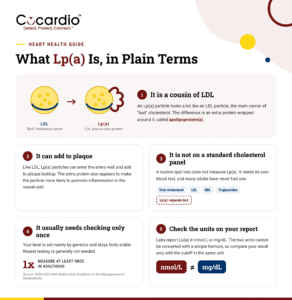
It is a cousin of LDL. An Lp(a) particle looks a lot like an LDL particle, the main carrier of “bad” cholesterol. The difference is an extra protein wrapped around it, called apolipoprotein(a).
It can add to plaque. Like LDL, Lp(a) particles can enter the artery wall and add to plaque buildup. The extra protein also appears to make the particle more likely to promote inflammation in the vessel wall.
It is not on a standard cholesterol panel. A routine lipid test does not measure Lp(a). It needs its own blood test, and many adults have never had one.
It usually needs checking only once. Because your level is set mainly by genetics and stays fairly stable, the 2026 ACC/AHA Multisociety Guideline on the Management of Dyslipidemia recommends measuring Lp(a) at least once in adulthood. Repeat testing is generally not needed.
Check the units on your report. Labs report Lp(a) in nmol/L or mg/dL. The two units cannot be converted with a simple formula, so compare your result only with the cutoff in the same unit.
What a High Result May Mean
The 2026 guideline treats an Lp(a) of 125 nmol/L or higher (50 mg/dL or higher) as a “risk-enhancing” factor. At that level, risk of heart attack or stroke is about 1.4 times higher than it would otherwise be. At 250 nmol/L (100 mg/dL) or above, it is at least twice as high.
Here is what that means in practice:
Your other numbers carry more weight. The guideline treats a high Lp(a) as a reason to consider more intensive LDL lowering and closer attention to other risk factors. A cholesterol level that might be watched in someone else may be worth acting on in you.
It may help explain your family story. If heart disease showed up early in a parent or grandparent who seemed otherwise healthy, Lp(a) is one possible reason.
It adds to your risk picture. These markers help us identify where we may be able to reduce risk. Lp(a) is one part of that picture, alongside blood pressure, blood sugar, LDL, ApoB, and your habits.
What a High Result Does Not Necessarily Mean
It does not mean you have heart disease. Lp(a) measures a risk, not a diagnosis. Many people with high levels never have a heart attack or stroke.
It does not mean your healthy habits were wasted. Exercise, good food, and good sleep still lower your overall risk. They simply work on other parts of the picture.
It does not mean you need a new medicine today. What your physician recommends depends on your whole risk profile, not on one number.
It is not a reason to change medication on your own. Medication may be one part of the strategy. Lifestyle and metabolic optimization remain important regardless.
It is not a family verdict. Lp(a) can be passed down from either parent, but each relative’s level has to be measured to be known.
Questions Worth Asking Your Physician
Take this list to your next visit:
- What was my exact Lp(a) result, and in which unit?
- Given my Lp(a), should my LDL or ApoB goal be lower than it is now?
- Where does my overall 10-year risk sit, and how much does Lp(a) move it?
- Would a coronary calcium score help show whether plaque has already formed?
- Should my parents, siblings, or children be tested?
- Is there anything about my blood pressure or blood sugar that we should tighten up?
What You Can Actually Do
Here is the honest answer to the question in the title. Diet, exercise, and weight loss change Lp(a) itself very little. What they change is everything around it, and that is where your risk can come down.
Lower the risks you can move. Think of Lp(a) as a fixed weight on one side of a scale. You cannot remove it, but you can take weight off the other side by bringing LDL, blood pressure, and blood sugar into healthy ranges.
Eat to lower LDL. A plant-forward pattern with plenty of beans, lentils, oats, vegetables, fruit, nuts, and whole grains supports lower LDL. Fewer processed meats, fried foods, and packaged snacks help too.
Build fitness steadily. Aim for at least 150 minutes of moderate activity a week, plus strength training on two days. Check with your doctor before starting a new exercise routine.
Keep blood sugar in check. Insulin resistance and diabetes add to the same artery damage Lp(a) contributes to. Waist size, fasting glucose, and HbA1c are worth tracking.
Treat blood pressure as a priority. Steady, healthy blood pressure reduces strain on your artery walls, which matters even more when Lp(a) is high.
Don’t smoke. Smoking damages the artery wall on top of what Lp(a) contributes.
Sleep and stress count too. Seven to nine hours of sleep and regular ways to unwind support healthier blood pressure and blood sugar over time.
When Further Assessment May Help
Coronary calcium scoring. A calcium score can show whether hardened plaque has already formed. For someone with high Lp(a), that can help your physician decide how hard to push on LDL.
ApoB testing. ApoB counts all the particles that can carry cholesterol into the artery wall. It can give a fuller view of risk when Lp(a) is high.
Family testing. The National Lipid Association notes that testing first-degree relatives (parents, siblings, children) of someone with high Lp(a) can find others who are at risk and may benefit from earlier prevention.
Specialist treatments. Lipoprotein apheresis, a procedure that filters particles from the blood, is FDA-approved only for a small group of high-risk patients who already have heart or vascular disease and whose LDL and Lp(a) stay high despite treatment. It is not a general treatment for high Lp(a).
New medicines in research. Several drugs designed to lower Lp(a) are being studied. In September 2026, the first large outcome trial of one of them, pelacarsen, reported that it lowered Lp(a) but did not meet its main goal of reducing a combined measure of heart attacks, strokes, and other major cardiovascular events compared with placebo. Full results have not yet been presented. Research on other drugs continues. For now, lowering your overall risk is the plan that has evidence behind it.
How CoCardio® Can Help
At CoCardio® in Encinitas, Dr Pratiksha G Gandhi MD, Preventive Heartcare Expert, helps people turn an inherited risk into a clear, practical prevention plan. The goal is to understand your complete cardiovascular picture.
If you have never had your Lp(a) checked, Dr Gandhi can order the test as part of a consultation. If you already know your number is high, we can look at it alongside your LDL, ApoB, blood pressure, blood sugar, and family history, and help you focus on the changes that matter for you.
Our approach follows three steps: Detect Early. Protect Fully. Connect Deeply. We work alongside your cardiologist and primary care doctor, and CoCardio® never advises starting, stopping, or changing prescribed medication.
Know your number, then make a plan. Book a consultation with CoCardio® to talk through your Lp(a) result and the steps that can lower your overall heart risk. Please share results only through our secure booking and intake process, never by email, social media, or public comments.
Frequently Asked Questions
Can I live a long life with high lipoprotein(a)?
Yes. Many people with high Lp(a) live long lives without a heart attack or stroke. A high level raises the odds, and that is a reason to manage your other risk factors carefully, not a prediction of what will happen.
How can I naturally lower my lipoprotein(a)?
Diet, exercise, and weight loss change Lp(a) very little, because it is mainly set by your genes. What lifestyle changes can do is lower LDL, blood pressure, and blood sugar, which reduces your overall risk.
What is a high Lp(a) level?
The 2026 guideline uses 125 nmol/L or higher, or 50 mg/dL or higher, as a level that adds to heart risk. Check which unit your lab used before comparing.
How often should Lp(a) be tested?
For most adults, once is enough. Your level stays fairly stable through life. Your physician may recheck it in specific situations.
Should my family be tested if my Lp(a) is high?
It is worth discussing. Lp(a) runs in families, and testing parents, siblings, and children can find others who could benefit from earlier prevention.
Is there a medicine for high Lp(a)?
As of October 2026, no medicine is approved specifically to lower Lp(a) to prevent heart attacks or strokes. Your physician may focus on lowering LDL and other risk factors, which does reduce risk.
Medical Disclaimer
This article is provided for general educational purposes and does not constitute medical advice, diagnosis, or treatment. Individual circumstances vary, and decisions regarding cardiovascular care should be made with appropriate healthcare professionals.
CoCardio® services are designed to complement, not replace, emergency care, a cardiologist, primary care physician, cardiac rehabilitation program, prescribed medication, diagnostic testing, or medically recommended procedures.
If you have new, severe, or worsening symptoms, seek appropriate medical attention rather than relying on information provided in this article.
Sources
Blumenthal RS, et al. 2026 ACC/AHA/AACVPR/ABC/ACPM/ADA/AGS/APhA/ASPC/NLA/PCNA Guideline on the Management of Dyslipidemia. Circulation. Published online March 13, 2026. doi:10.1161/CIR.0000000000001423
National Lipid Association. A focused update to the 2019 NLA scientific statement on use of lipoprotein(a) in clinical practice. Journal of Clinical Lipidology. 2024. doi:10.1016/j.jacl.2024.03.001
Novartis. Lp(a)HORIZON Phase III topline results for pelacarsen. Press release, September 4, 2026. https://www.novartis.com/news/media-releases/novartis-announces-lpahorizon-phase-iii-topline-results-pelacarsen-patients-elevated-lpa-and-established-cardiovascular-disease-cvd