Fifteen Minutes and a Page Full of Numbers
Most doctor visits are short. You might have fifteen minutes, a printout with dozens of results, and a few lines marked high or low. It is easy to spend the whole visit on whichever number looks scariest and leave without a plan.
There is a better way to use that time. You don’t need to understand every line on your report. You need to understand a handful of markers that, taken together, describe your heart risk from different angles.
This guide walks through seven of them. Some are already on your last lab report. One or two may never have been checked. For each one, you’ll learn what it measures, what a high result may point to, and what it can’t tell you on its own. Then you’ll have a short list of questions to take with you.
Important: This article is for education only and cannot interpret your personal results. New, worsening, or persistent chest discomfort needs prompt medical attention. Call 911 if you think you may be having an emergency.
Why One Marker Is Never the Whole Story
A lab report lists results in rows, one at a time. Your body doesn’t work that way.
Several markers often move together because they share a cause. Insulin resistance, for example, can raise blood sugar, triglycerides, ApoB, and inflammation all at once. On paper, that looks like four problems. In your body, it may be one pattern, and addressing the pattern may improve all four.
A reference range is also built from a large population, not from you. A result just outside the range is a reason to look closer, not a diagnosis. These markers help us identify where we may be able to reduce risk. They make the most sense when read together and alongside your history.
The Seven Markers
- LDL and Non-HDL Cholesterol
LDL is the cholesterol most closely tied to plaque. Non-HDL cholesterol is your total cholesterol minus HDL, and it captures LDL plus other plaque-forming particles. Both appear on a standard cholesterol panel.
The 2026 ACC/AHA Multisociety Guideline on the Management of Dyslipidemia brought back specific LDL goals, and those goals depend on your overall risk. A number that is fine for one person may be too high for another. If you were prescribed a statin and want to know what else you can do, our article on that topic covers it in detail.
- ApoB
ApoB counts the particles that carry cholesterol into the artery wall. It doesn’t measure how much cholesterol they carry. It can be high even when LDL looks normal, especially with high triglycerides, insulin resistance, or diabetes. The 2026 guideline supports testing it in those situations to find risk a standard panel can miss.
Good news: ApoB can respond to diet, weight, activity, and medication when needed.
- Lipoprotein(a)
Lp(a) is an LDL-like particle whose level is mainly set by your genes. The 2026 guideline recommends measuring it at least once in adulthood and treats 125 nmol/L (50 mg/dL) or higher as a factor that raises risk.
Lifestyle changes it very little, so a high result is not a sign you did something wrong. What it does change is how carefully your other numbers should be managed.
- Triglycerides, Glucose, and HbA1c
These three show how your body handles fuel. Triglycerides of 150 mg/dL or higher, a fasting glucose of 100 to 125 mg/dL, or an HbA1c of 5.7 to 6.4 percent can all point toward insulin resistance or prediabetes.
They matter for your heart because the same metabolic pattern raises ApoB and inflammation and speeds up plaque. They are also among the markers that respond most to eating habits, activity, sleep, and weight around the middle.
- hs-CRP
High-sensitivity C-reactive protein is a measure of low-level inflammation in the body. Inflammation plays a part in how plaque forms and becomes unstable.
One result can be misleading, since a cold, an injury, or a hard workout can raise it for a while. The 2026 guideline treats an hs-CRP of 2 mg/L or higher as a factor that can raise risk. Because one reading can mislead, it is usually repeated before it counts.
- Blood Pressure
This is the one marker that isn’t a blood test, and the one people most often skip while studying their cholesterol. Blood pressure puts steady strain on artery walls and adds to almost every other risk on this list.
A reading of 130/80 mmHg or above is considered high. A single office reading can be off, so a week of home readings often gives a truer picture.
- Coronary Artery Calcium Score
A calcium score is a quick CT scan, not a blood test. It looks at the arteries themselves and shows whether hardened plaque is already present. For adults at borderline or intermediate risk, generally men 40 and older and women 45 and older, it can help decide how intensive prevention should be.
A score of zero is reassuring but does not rule out soft plaque. A score above zero usually shifts the conversation toward earlier, more active prevention.
What These Markers Don’t Necessarily Mean
- Several flags don’t mean a heart attack is coming. They show where risk may be building and where there is room to lower it.
- One result is a snapshot, not a trend. Many of these markers vary from day to day. Some are worth repeating before acting on them.
- Normal results don’t guarantee zero risk. Family history, smoking, and markers that were never tested still count.
- An inherited marker isn’t a personal failure. Lp(a) and some cholesterol disorders are passed down. You can’t change the gene, but you can manage everything around it.
- Your results are not a reason to change medication on your own. Medication may be one part of the strategy. Lifestyle and metabolic optimization remain important regardless.
Six Questions to Bring to Your Visit
- Which of these seven markers matter most for me, and which haven’t been checked yet?
- Do any of my results point to one shared cause, like insulin resistance?
- Should any result be repeated before we act on it?
- What LDL or ApoB goal fits my overall risk?
- Have I had my Lp(a) measured?
- Would a calcium score change what we do next?
Small Changes That Move Several Markers at Once
Because these markers are linked, a few steady habits can improve many of them together.
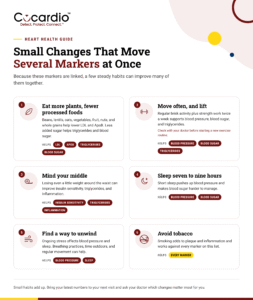
- Eat more plants and fewer processed foods. Beans, lentils, oats, vegetables, fruit, nuts, and whole grains help lower LDL and ApoB. Less added sugar helps triglycerides and blood sugar.
- Move often, and lift. Regular brisk activity plus strength work twice a week supports blood pressure, blood sugar, and triglycerides. Check with your doctor before starting a new exercise routine.
- Mind your middle. Losing even a little weight around the waist may improve insulin sensitivity, triglycerides, and inflammation.
- Sleep seven to nine hours. Short sleep pushes up blood pressure and makes blood sugar harder to manage.
- Find a way to unwind. Ongoing stress affects blood pressure and sleep. Breathing practices, time outdoors, and regular movement can help.
- Avoid tobacco. Smoking adds to plaque and inflammation and works against every marker on this list.
When Imaging May Add Clarity
Blood tests describe risk. Imaging can show whether plaque is actually there. Your physician may discuss:
- A calcium score, when your risk sits in the middle and a clearer picture would change the decision.
- Coronary CT angiography (CCTA), which uses contrast dye and radiation to show the arteries, including soft plaque. It is often considered when there are symptoms or when soft plaque is more likely. It is not a routine screening test.
- Repeat testing, such as a second hs-CRP or a recheck of ApoB after a few months of changes.
Each of these is a decision to make with your physician based on your situation.
How CoCardio® Can Help
At CoCardio® in Encinitas, Dr Pratiksha G Gandhi MD, Preventive Heartcare Expert, helps people read these markers together and build a plan around what they show. The goal is to understand your complete cardiovascular picture.
Our approach follows three steps: Detect Early. Protect Fully. Connect Deeply. We partner with your cardiologist and primary care doctor. CoCardio® never advises starting, stopping, or changing prescribed medication.
Bring your results. Leave with a plan. Book a consultation with CoCardio® to go through your markers together and decide what matters most for you. Please share results only through our secure booking and intake process, never by email, social media, or public comments.
Frequently Asked Questions
What blood tests show heart health?
A standard cholesterol panel, ApoB, Lp(a), triglycerides, fasting glucose or HbA1c, and hs-CRP together give a broad view. Blood pressure and, for some people, a calcium score complete the picture.
Should I ask for ApoB and Lp(a) if my doctor hasn’t ordered them?
It is reasonable to ask. The 2026 guideline recommends Lp(a) at least once in adulthood and supports ApoB testing in certain situations.
If several of my markers are high, am I going to have a heart attack?
No, not necessarily. Several flags often share one cause, and they show where there is room to reduce risk.
Do I need all seven tests?
It depends. Your physician will decide which ones fit your age, history, and risk.
How often should these markers be checked?
It depends on the marker. Lp(a) is usually checked once. Cholesterol, ApoB, and blood sugar are often rechecked after changes or yearly. A calcium score of zero is typically repeated after several years.
Can lifestyle changes improve these numbers?
For most of them, yes, they can improve with steady changes, though how much varies from person to person. LDL, ApoB, triglycerides, blood sugar, hs-CRP, and blood pressure can all respond. Lp(a) is the exception.
Medical Disclaimer
This article is provided for general educational purposes and does not constitute medical advice, diagnosis, or treatment. Individual circumstances vary, and decisions regarding cardiovascular care should be made with appropriate healthcare professionals.
CoCardio® services are designed to complement, not replace, emergency care, a cardiologist, primary care physician, cardiac rehabilitation program, prescribed medication, diagnostic testing, or medically recommended procedures.
If you have new, severe, or worsening symptoms, seek appropriate medical attention rather than relying on information provided in this article.
Sources
Blumenthal RS, et al. 2026 ACC/AHA/AACVPR/ABC/ACPM/ADA/AGS/APhA/ASPC/NLA/PCNA Guideline on the Management of Dyslipidemia. Circulation. Published online March 13, 2026. doi:10.1161/CIR.0000000000001423
American Diabetes Association. Standards of Care in Diabetes 2026. Diabetes Care. Section 2: Diagnosis and Classification of Diabetes (prediabetes ranges for fasting glucose and HbA1c). [DOI to confirm]
2025 AHA/ACC/AANP/AAPA/ABC/ACCP/ACPM/AGS/AMA/ASPC/NMA/PCNA/SGIM Guideline for the Prevention, Detection, Evaluation and Management of High Blood Pressure in Adults. Hypertension and Circulation. 2025. [Lead author and DOI to confirm] (130/80 mmHg threshold).