Your Cholesterol Says One Thing. Your Scan Says Another.
You opened two results in the same week. Your LDL cholesterol was flagged as high. Your coronary artery calcium scan, the test you hoped would settle the question, came back as a zero.
So which one should you believe?
Many people feel relief first and doubt second. If the scan found nothing, does the cholesterol still matter? If the cholesterol matters, why did the scan find nothing?
Here is the short answer. Both results can be true at the same time, and neither one cancels the other. A zero calcium score is good news. A high cholesterol number is still worth acting on. What you do next depends on the rest of your health picture, and that is a decision to make with your physician, not alone at the kitchen table.
This guide explains what each result is telling you, when a zero is strong evidence, and when it can mislead.
Important: This article is for education only and cannot interpret your personal results. New, worsening, or persistent chest discomfort needs prompt medical attention. Call 911 if you think you may be having an emergency.
Two Tests Answering Two Different Questions
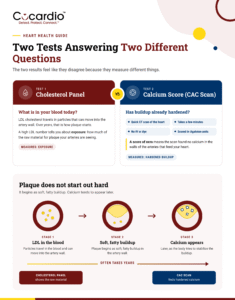
The two results feel like they disagree because they measure different things.
Your cholesterol panel looks at what is in your blood today. LDL cholesterol travels in particles that can move into the artery wall. Over years, that is how plaque starts. A high LDL number tells you about exposure: how much of the raw material for plaque your arteries are seeing.
Your calcium score looks for buildup that has already hardened. A coronary artery calcium (CAC) scan is a quick CT scan of the heart. It takes a few minutes, needs no IV or dye, and gives a score in Agatston units. A score of zero means the scan found no calcium in the walls of the arteries that feed your heart.
Plaque does not start out hard. It begins as soft, fatty buildup. Calcium tends to appear later, as the body tries to stabilize that buildup, and the process often takes years.
One way to picture it: high cholesterol is like years of rain falling on a metal roof. The calcium scan looks for rust. Finding no rust is good news. It does not mean the rain has stopped.
So the scan answered one question: has plaque hardened enough to see yet? Your cholesterol raises a different one: how much exposure are your arteries getting, and for how long? Both questions matter.
What a Zero Score May Mean for You
A zero is valuable information, and it is fair to feel encouraged by it.
Your near-term risk is likely lower than your cholesterol alone suggests. People with no detectable coronary calcium have a low rate of heart attacks over the next several years compared with people who do have calcium. That is why doctors use the scan to refine risk when a treatment decision is uncertain.
It may give you time. The 2026 ACC/AHA Multisociety Guideline on the Management of Dyslipidemia says that for adults at intermediate risk, and some at borderline risk, a CAC score of zero can make it reasonable to hold off on cholesterol-lowering medication. That applies when no higher-risk conditions are present, and the person prefers to focus on lifestyle first. Risk is then reassessed after a few years.
It turns a worry into a plan. These markers help us identify where we may be able to reduce risk. A zero tells you the window for prevention is still wide open, and using that window well is the opportunity.
What a Zero Score Does Not Necessarily Mean
A zero is narrower than it looks. Here is what it does not tell you on its own.
It does not mean your arteries are free of plaque. Soft, noncalcified plaque does not show up on a calcium scan, and it can be present at any age.
It does not cancel out higher-risk conditions. Guidelines list situations in which a zero should not be used as a reason to wait: LDL of 190 mg/dL or higher or familial hypercholesterolemia, diabetes after age 40, current smoking, and a strong family history of early heart disease. That usually means a father or brother diagnosed before 55, or a mother or sister before 65.
It does not make high cholesterol harmless. Your arteries respond to cholesterol exposure added up over a lifetime. A zero today says the buildup has not hardened yet, not that the exposure stopped counting.
It does not last forever. In a large analysis from the Multi-Ethnic Study of Atherosclerosis (MESA), the period during which a zero stayed reliable ranged from three to seven years, and it was shorter in people with diabetes.
It is not a signal to change your current medication. A zero score is information for your physician, not a reason to stop anything.
Medication may be one part of the strategy. Lifestyle and metabolic optimization remain important regardless. A zero score does not change that.
Six Questions to Take to Your Next Appointment
Bring these with you. They help turn two confusing results into one clear plan.
- Where does my 10-year risk fall on the PREVENT calculator, and did my zero score change it?
- Do I have any condition, such as diabetes, smoking, very high LDL, or early heart disease in my family, that makes my zero less reassuring?
- Have we checked my Lp(a) and ApoB, and would either one change your advice?
- If we hold off on medication for now, what result would change your mind?
- When should we repeat my calcium scan?
- Would a CT angiogram add anything in my situation?
How to Use the Time Your Zero Gives You
When a guideline supports waiting on medication, it does so on the condition that lifestyle becomes the focus. That makes these steps the core of the plan, not an extra.
Eat more fiber and fewer ultra-processed foods. Beans, oats, lentils, vegetables, fruit, nuts, and whole grains are rich in soluble fiber, which helps lower LDL. Cutting back on processed meats, fried foods, and packaged snacks reduces saturated fat and added sugar at the same time.
Move on most days, and add strength work. Aim for at least 150 minutes of moderate activity a week, such as brisk walking, plus muscle-strengthening exercise on two days. Check with your doctor before starting a new exercise routine.
Watch your waistline as well as the scale. Fat stored around the middle is closely linked to insulin resistance, which affects both cholesterol and blood sugar.
Know your blood pressure. High blood pressure strains the artery wall and speeds up plaque. Home readings give your doctor a truer picture than a single office visit.
Protect your sleep. Seven to nine hours a night supports healthy blood pressure, blood sugar, and appetite.
Give stress somewhere to go. Breathing practices, time outdoors, and regular movement help calm the stress response, which affects blood pressure and sleep.
Stay smoke-free. If you smoke, quitting lowers your risk, and it removes one of the conditions that limits what a zero score can tell you.
Recheck your numbers. A repeat cholesterol panel after a few months of changes shows whether your plan is working.
When a Closer Look May Be Worth Discussing
For many people, the next step is steady habits and a repeat scan in a few years. For some, your physician may want more information sooner.
A repeat calcium scan. This is usually done three to seven years after a zero, and often sooner with diabetes, based on research from MESA. The 2026 guideline does not recommend repeat scans to check whether treatment is working, because calcium can still rise while LDL improves.
Lp(a) and ApoB. The 2026 guideline recommends measuring Lp(a) at least once in adulthood. Lp(a) is largely inherited, so a high result is not something you caused. ApoB counts the particles that carry cholesterol and can show risk that an LDL number misses.
Coronary CT angiography (CCTA). This scan uses contrast dye and radiation to show the arteries themselves, including soft plaque. Your physician may consider it for people likely to have more noncalcified plaque, such as those with diabetes or chronic inflammatory conditions. It is not a routine screening test.
Symptoms need their own evaluation. A calcium score is a screening tool for people without symptoms. Chest pressure, shortness of breath, or unusual tiredness with activity should be checked by a doctor, whatever your score.
How CoCardio® Helps You See the Whole Picture
At CoCardio® in Encinitas, Dr Pratiksha G Gandhi MD, Preventive Heartcare Expert, helps people make sense of results like these and build a prevention plan around them. The goal is to understand your complete cardiovascular picture. That means your numbers, your family history, your daily habits, and what matters to you.
Our approach comes down to three steps: Detect Early. Protect Fully. Connect Deeply.
We work alongside your cardiologist and primary care doctor. CoCardio® never advises starting, stopping, or changing prescribed medication.
A Patient Story: Mr N
Only with Mr N’s signed authorization.
Mr N came to CoCardio® with numbers that sat right on the edge. His blood pressure and cholesterol were both borderline high, and his father had undergone bypass surgery. He was active, a surfer who cared about performance, and he wanted to understand his risk fully before making any decisions about medication.
His story shows why a single number is never the whole plan. Family history is one of the factors that changes how much reassurance any test can offer, so his plan was built around his complete picture, including sleep, stress, exercise, and regular follow-up with his own doctors.
One person’s experience is not a prediction of yours. What Mr N’s story does show is the value of treating borderline numbers as a reason to act early.
Ready to read your results together? If your cholesterol and your calcium score seem to be telling two different stories, book a consultation with CoCardio® to talk through what they mean for you and what to do next. Please share results only through our secure booking and intake process, never by email, social media, or public comments.
Frequently Asked Questions
Do I need a statin if my CAC score is zero?
Not always. Under the 2026 guideline, a zero can make it reasonable to hold off for adults at intermediate or some borderline risk, as long as no higher-risk conditions are present. Very high LDL, diabetes after 40, smoking, or a strong family history of early heart disease can change that answer. Your physician makes this call with your full picture.
At what calcium score do you start taking statins?
For adults at intermediate or select borderline risk, a score above zero generally favors starting cholesterol-lowering therapy, and a score of 100 or higher, or at the 75th percentile or above for age and sex, supports more intensive treatment.
Can you have heart disease with a calcium score of zero?
Yes. Soft plaque that has not yet calcified does not appear on the scan. That is one reason a zero is reassuring but not a guarantee.
How often should a zero calcium score be repeated?
It depends. Research from MESA suggests three to seven years for many people, and diabetes often shortens that window. Your physician will set the interval that fits you.
Is a zero calcium score common with high cholesterol?
Yes, especially in younger adults. Cholesterol can be high for years before any plaque hardens enough to show up on a scan.
Can I stop my cholesterol medication if my score is zero?
Don’t stop it on your own. Talk with the physician who prescribed it. A zero is one piece of information, not a reason to change your treatment by yourself.
Medical Disclaimer
This article is provided for general educational purposes and does not constitute medical advice, diagnosis, or treatment. Individual circumstances vary, and decisions regarding cardiovascular care should be made with appropriate healthcare professionals.
CoCardio® services are designed to complement, not replace, emergency care, a cardiologist, primary care physician, cardiac rehabilitation program, prescribed medication, diagnostic testing, or medically recommended procedures.
If you have new, severe, or worsening symptoms, seek appropriate medical attention rather than relying on information provided in this article.
Sources
2026 ACC/AHA/AACVPR/ABC/ACPM/ADA/AGS/APhA/ASPC/NLA/PCNA Guideline on the Management of Dyslipidemia. Journal of the American College of Cardiology and Circulation, published online March 13, 2026. Press release: https://www.acc.org/About-ACC/Press-Releases/2026/03/13/18/01/ACCAHA-Issue-Updated-Guideline-for-Managing-Lipids-Cholesterol
Dzaye O, Dardari ZA, Cainzos-Achirica M, et al. Warranty Period of a Calcium Score of Zero: Comprehensive Analysis From MESA. JACC: Cardiovascular Imaging. 2021;14(5):990-1002. doi:10.1016/j.jcmg.2020.06.048