Privacy note: This story is shared with the patient’s written authorization. “Joan” is a pseudonym, though some details in this article and in linked materials may identify her. This article describes one patient’s reported experience. It should not be read as a prediction of the results another patient may have.
Quick Answer
Can ECP/EECP® therapy help someone who does not want heart surgery?
Yes, for some people, and only after careful evaluation and screening.
ECP/EECP® therapy may be added to a personalized heart care plan alongside a person’s existing medical treatment.
This is the story of one patient. She was living with serious coronary artery disease, worsening symptoms, and shrinking independence. Doctors tried to place a stent, but could not. Bypass surgery was then recommended. After talking it over with her medical team, she made the personal choice not to have surgery at that time. She later came to CoCardio® looking for more support.
After an individual evaluation, ECP/EECP® was added to a broader plan that worked alongside her medical care. During her program, she reported less chest discomfort, better energy and breathing, and more confidence in daily life. At her follow-up, she had not had the recommended surgery and reported that she was doing much better day to day. Any future medical or surgical decisions stayed between her and her medical team.
Her experience is her own. ECP/EECP® does not replace bypass surgery, medication, cardiac rehab, or other recommended care, and it is not right for everyone. Results vary from person to person.
The Day the Car Keys Stayed on the Hook
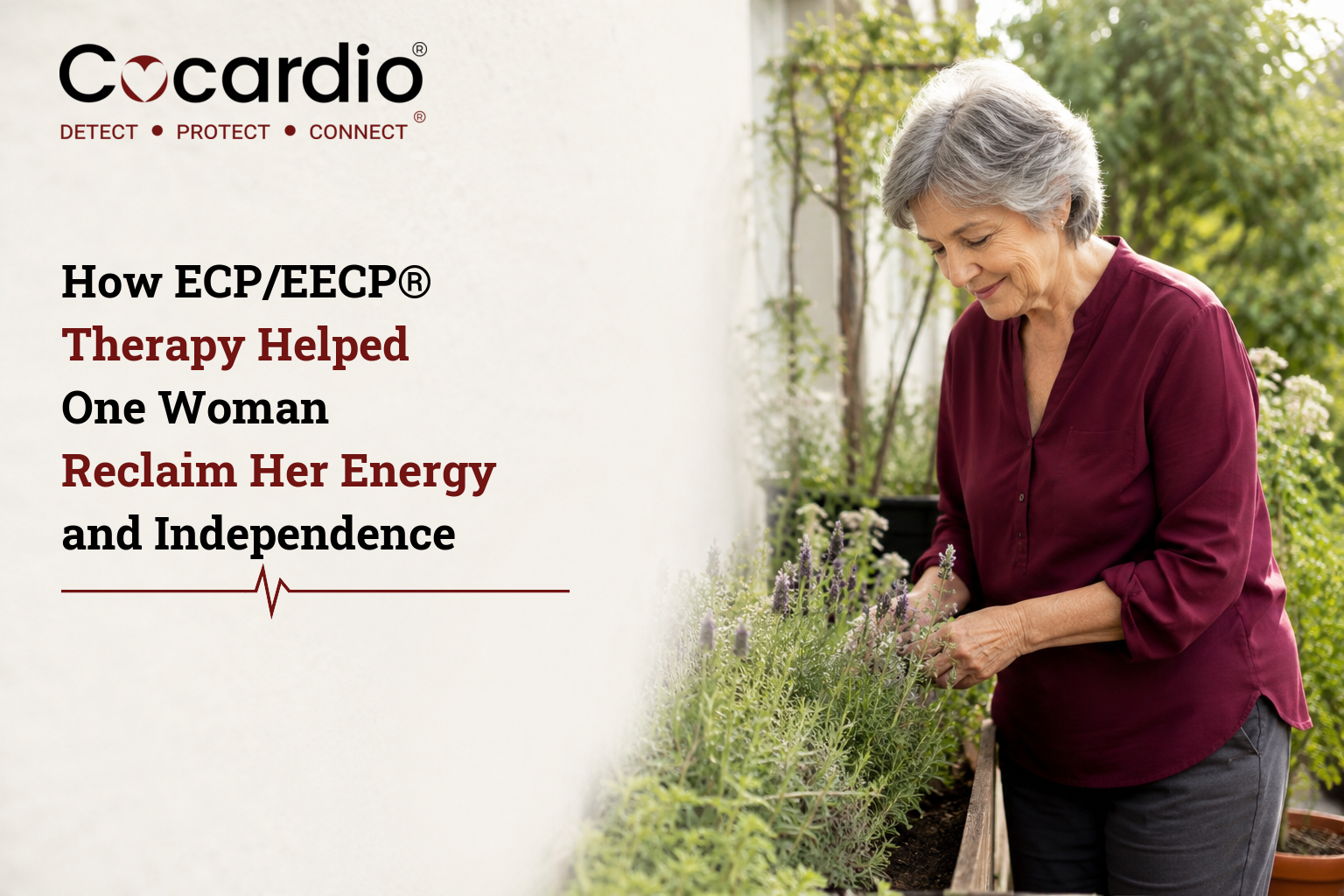
Joan never announced it. There was no single dramatic moment. One week she was driving herself to the grocery store, the way she had for more than sixty years. A few weeks later, the keys simply stayed on the hook by the door.
At some point, without ever quite deciding to, a woman in her eighties had begun giving up her life one small piece at a time.
Everything She Was Carrying
Joan was not dealing with one condition. She was dealing with several at once, and each one made the others harder.
She had lived with high blood pressure for years. Diabetes added its own daily routine of monitoring and careful eating, along with its own slow pressure on her blood vessels. Her doctors described the whole picture as cardiometabolic disease. That means her blood pressure, blood sugar, and heart health were all tangled together, each one making the others tougher to manage.
Underneath it all sat the most serious diagnosis of the group: ischemic heart disease. The arteries that feed her own heart muscle had narrowed, so her heart was not getting all the blood it needed.
For a long time, Joan managed. She adapted. She kept going. She even changed decades of eating habits and committed to a plant-based, low-fat program, because she wanted to give her heart every advantage she could.
But by the summer of her hardest year, managing was no longer enough. Her body was telling her something had changed.
The fatigue came first. Not ordinary tiredness that a good night’s sleep could fix. This was a heaviness that settled into her bones. The walk from a parking lot to a store entrance felt like a mountain trail. Standing at the stove to cook a meal left her needing to sit down.
Then came the chest pressure. A squeezing, weighted feeling behind her breastbone. Doctors call it angina. At first it showed up with effort: climbing steps, carrying groceries, walking uphill. Then it began arriving with less and less provocation. Sometimes a stressful phone call was enough. Her symptoms were triggered by worry as easily as by exercise, so there was almost nowhere in her day she felt safe from them.
Her breath grew short. Small tasks left her stopping to catch her breath. Making a bed. Watering plants. Walking to the mailbox.
Her stamina kept slipping. Errands were postponed, then handed off, then abandoned. Things she had done on her own all her life started to feel out of reach. The nitroglycerin tablet in her purse stopped being an emergency measure. She reached for it again and again as the angina came back.
Maybe the heaviest loss was not physical. It was confidence. When you can no longer trust your body to get you through an ordinary afternoon, you stop planning ordinary afternoons. Joan’s world was getting smaller, and she could feel it happening.
The Summer of Hard News
Her medical team took her worsening symptoms seriously. That summer she had a full evaluation, including a stress test. The findings were sobering: severe coronary artery disease.
The narrowing was significant enough that her doctors moved quickly to a cardiac catheterization, hoping to open the blockages with a stent. Joan went into that procedure with a reasonable hope. Maybe a stent would restore blood flow and give her back some of what she had lost.
It did not work out. The blockage was too complex for the stent to be placed.
That is a hard moment for any patient. The less invasive fix was off the table. What remained was the recommendation her doctors now made: quadruple coronary artery bypass graft surgery, often called quadruple bypass surgery. It is a major operation with a long recovery, especially for a woman in her eighties.
So Joan went home from that summer with three things. A serious diagnosis. A failed stent attempt. And a surgical recommendation. The angina kept coming back. The nitroglycerin kept coming out of her purse. Daily tasks stayed hard, and her independence kept slipping.
Watch More: JG – Client Testimonial CoCardio Encinitas
The Decision That Was Hers to Make
Joan sat with the surgical recommendation for a long time. She weighed her age. She weighed what open-heart surgery and months of recovery would ask of a body already worn out. She weighed her other conditions and what she wanted the years ahead to look like.
After careful thought, and with a full understanding of what her medical team advised, she made a deeply personal, informed decision. Because of her age, she would not have surgery at that time.
That decision was hers to make. This article does not suggest it is the right decision for anyone else. Decisions about surgery belong with each patient and the qualified medical professionals responsible for their care.
But her decision left her at a crossroads that many patients reach and few know how to navigate.
If not surgery, then what?
Joan had no intention of doing nothing. She was still living with angina. Still short of breath. Still watching her stamina fade. Her goal was clear to her: she wanted to improve her heart health and take an active part in it, on terms her body and her values could accept. She had already proven her commitment through her lifestyle changes. Now she wanted a partner who would take that commitment seriously and build on it.
That search is what brought her to CoCardio®.
The First Appointment That Wasn’t About a Treatment
Joan expected to be handed a program. Instead, she was asked questions.
At CoCardio®, we do not begin with a treatment. We begin by understanding the person. Joan’s first visit was a consultation. Our team reviewed her health history, including her high blood pressure, diabetes, and cardiometabolic picture. We reviewed her recent evaluations, including the failed stent attempt and the surgical recommendation. We talked through her current medical care, her goals, and the safety considerations that mattered for someone with her condition.
Her existing medical care was not set aside. It was part of the conversation from day one, because our services are designed to complement, rather than replace, established medical care.
Only after that review did our team decide that ECP/EECP® therapy might have an appropriate role in her personalized cardiovascular wellness plan.
What Is ECP/EECP® Therapy?
Enhanced External Counterpulsation, known as ECP or EECP®, is a noninvasive therapy. Inflatable cuffs are placed around the legs. They inflate and deflate in rhythm with the heartbeat, timed to the person’s ECG. The therapy is given as a series of sessions over several weeks. There are no incisions, no anesthesia, and no hospital stay. For Joan, a woman who had just declined an operation, that mattered a great deal.
ECP/EECP® therapy is not a cure, and it is not right for every person. It may be considered for appropriately screened patients after a consultation, as an adjunct that works alongside a person’s existing medical care.
An Orchestrated, Proactive Plan
ECP was only one thread of Joan’s plan. Her CoCardio® program was built to work alongside her established cardiac care, with every piece chosen to support the others.
Lifestyle and nutrition support. Her plan did not replace the plant-based, low-fat eating pattern she had already adopted. It built on the foundation she had laid herself.
Stress reduction and meditation. Stress was one of her known angina triggers, so learning to calm her nervous system was not a nice extra. It was a core part of her plan.
Support for cellular and blood vessel health. Strategies aimed at supporting her cells’ energy systems and the delicate inner lining of her blood vessels.
One person. One connected plan. Built around her history, her conditions, her goals, and her choices.
Thirty-Five Sessions: Her World Began to Widen
In late 2024, Joan began her course of ECP therapy. She completed 35 sessions over about three months.
The change did not arrive overnight. It arrived the way it had left: slowly.
In the early weeks, the shifts were quiet. The chest pressure showed up less often. Episodes that once came with a stressful phone call or a short walk grew further apart. She reached for the nitroglycerin less and less, until she was using it far less than before. Her breathing eased. Walking felt less like a negotiation with her body and more like simply walking.
Then her energy began to return. Not all at once, but she noticed. Afternoons stopped defeating her. She finished tasks she used to abandon halfway through. And with the energy came something she had not expected: her thinking felt clearer. She felt sharper, more present, more herself.
Then came the moment that meant more to her than any measurement.
Joan took the car keys off the hook.
She drove herself, alone, for the first time in months. A short trip. An ordinary errand. The kind of thing millions of people do without a second thought, and the kind of thing she had quietly believed she might never do again. She came home less tired than she expected. She went out again the next week, and the week after that.
Errands that once wore her out became manageable. With every trip, every visit, every day that ended with energy to spare, her confidence grew back. The same confidence that had been quietly slipping away for so long.
Where Joan Is Now
By the time she finished her thirty-fifth session, about three months after that first consultation, Joan reported that she was doing much better day to day. At her follow-up after the program, she reported no return of her angina. She was driving, running her own errands, managing her home, and living with an independence she had been steadily losing only months before.
Joan had not had the recommended surgery as of her follow-up. Any future decisions about surgery remain between Joan and her medical team. What changed is that she is no longer a passenger in her own heart health.
Her story did not end at session thirty-five, because proactive care is not a single chapter. Joan continues with preventive follow-up and ongoing monitoring, staying engaged with her health and her healthcare team. That continuity is the point. Wellness, at any age, is something you keep taking part in.
What Her Story Teaches
Joan’s journey is hers alone, and no single story predicts another person’s results. But it shows the principles at the heart of the CoCardio® approach.
She was understood before she was treated. The consultation was not a formality or a delay. It is how her plan came to fit her: her conditions, her history, and her goals.
She never had to choose between CoCardio® and her doctors. Her plan worked alongside her ongoing medical care and monitoring, never in place of it.
Her whole health was addressed, not one symptom. ECP sessions, nutrition, stress reduction, and cellular health support worked together as one plan, because conditions like hers do not exist in isolation.
She did the work. Thirty-five sessions completed. A lifestyle program sustained. Meditation practiced. Meaningful wellness takes participation, and Joan took part fully.
Her decision about surgery was her own. ECP/EECP® therapy did not remove the need for any medical procedure. Decisions about surgery belong with a patient and the qualified medical professionals responsible for their care. What her plan gave her was a way to take an active part in her heart health after she had made her choice.
Frequently Asked Questions
Can ECP/EECP® therapy replace heart surgery, medication, or cardiac rehab?
No. ECP/EECP® therapy does not replace surgery, medication, cardiac rehab, or any recommended procedure. Treatment decisions should always be made with the qualified medical professionals responsible for your care.
Can ECP/EECP® therapy work alongside my current heart care?
Yes. For appropriately screened people, ECP/EECP® therapy may complement established cardiovascular care as an adjunct to it.
Is a consultation required before starting ECP/EECP® therapy?
Yes. A consultation lets our team review your health history, current medical care, goals, and relevant safety considerations. ECP/EECP® therapy is not right for every person or every condition.
Can someone with high blood pressure, diabetes, or several conditions be considered?
It depends. Many people exploring preventive heart wellness live with more than one condition. Whether ECP/EECP® therapy may be appropriate depends on your full health picture, your current care, and what the evaluation finds. Consultation and screening come first.
Do results vary from person to person?
Yes. Results can vary based on health history, overall condition, consistency, and other factors. Joan’s story reflects her reported experience. It does not guarantee the same outcome for anyone else.
Can I use HSA or FSA funds at CoCardio®?
Yes, eligible HSA and FSA payments may be accepted. CoCardio® is a cash-pay practice and does not bill insurance for consultations, ECP sessions, or preventive cardiovascular wellness services. Please confirm eligibility and payment rules with your plan administrator.
Your Story Is Still Being Written
Joan faced severe coronary artery disease, a failed stent, a surgical recommendation, returning angina, and the slow loss of her independence. Her turning point was not a therapy. It was a decision to take an active part in her own heart health, and to find a team that would build a plan around her, not around a procedure.
If her story sounds familiar, your first step is a consultation so we can understand your health history, goals, current care, and whether CoCardio® services may be appropriate as part of your personalized cardiovascular wellness plan.
For your privacy, please do not share personal health information in public comments or unsecured messages. To discuss your situation, please contact our office directly through appropriate channels.
This article is provided for general educational purposes and does not constitute medical advice, diagnosis, or treatment. Individual circumstances vary, and decisions regarding cardiovascular care should be made with appropriate healthcare professionals.
CoCardio® services are designed to complement, not replace, emergency care, a cardiologist, primary care physician, cardiac rehabilitation program, prescribed medication, diagnostic testing, or medically recommended procedures.
If you have new, severe, or worsening symptoms, seek appropriate medical attention rather than relying on information provided in this article.
EECP® is a registered trademark of Vasomedical Inc., NY.