If you or someone you love is living with coronary artery disease, you have probably encountered a range of terms: angioplasty, stents, bypass, and perhaps, somewhere along the way, ECP or EECP® therapy. It is natural to wonder how these relate to each other. Are they alternatives? Competitors? Complements?
This article exists to answer that question honestly, because the honest answer matters: ECP/EECP® therapy and angioplasty with stenting are fundamentally different things, serving different purposes, decided in different ways. Understanding both can help you have better, more informed conversations with your healthcare team. It should never be used to choose one over the other on your own.
One essential note before we begin: new, severe, or worsening symptoms may require immediate medical attention. This article is for educational purposes and should not be used to evaluate urgent symptoms. During a heart attack or unstable symptoms, procedures like emergency angioplasty can be lifesaving, and nothing in this article should ever delay emergency care.
Quick Answer
Which is right for me: ECP/EECP® therapy, or angioplasty and stents?
It depends, because this is not an either/or decision, and the two are not interchangeable.
Angioplasty and stenting are medical procedures performed by interventional cardiologists to physically open narrowed or blocked coronary arteries. The decision to perform them belongs entirely to you and your cardiology team.
ECP/EECP® therapy is a noninvasive, session-based therapy that may be considered, for appropriately screened individuals, as an adjunct to cardiac care. This may include some people with chronic stable angina who are not candidates for procedures, who continue to experience symptoms after procedures, or who want additional noninvasive support alongside their medical care.
One does not replace the other. The right question is not “which one instead,” but “what does my individual situation call for,” and that question is answered with your healthcare team, following appropriate evaluation.
What Does An Angioplasty Entail?
Angioplasty, formally called percutaneous coronary intervention or PCI, is a procedure performed by an interventional cardiologist. A thin catheter is guided through a blood vessel to the site of a narrowed or blocked coronary artery, where a small balloon is inflated to open the vessel. In most cases, a stent, a small mesh tube, is then placed to help hold the artery open.
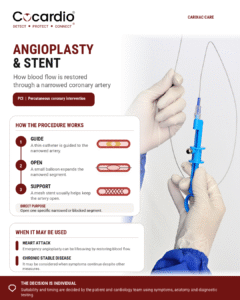
Angioplasty and stenting serve a direct mechanical purpose: restoring blood flow through a specific blocked or narrowed segment of artery. In the setting of a heart attack, emergency angioplasty can be lifesaving. In chronic stable disease, it may be recommended to relieve symptoms when medications and other measures are not enough, based on the individual’s anatomy, symptoms, and overall picture.
These are medical procedures with established roles in cardiology. Whether a procedure is appropriate, and when, is a decision made between a patient and the cardiology team responsible for their care, based on diagnostic testing and clinical judgment. Nothing in preventive wellness changes that.
What Is ECP/EECP® Therapy?
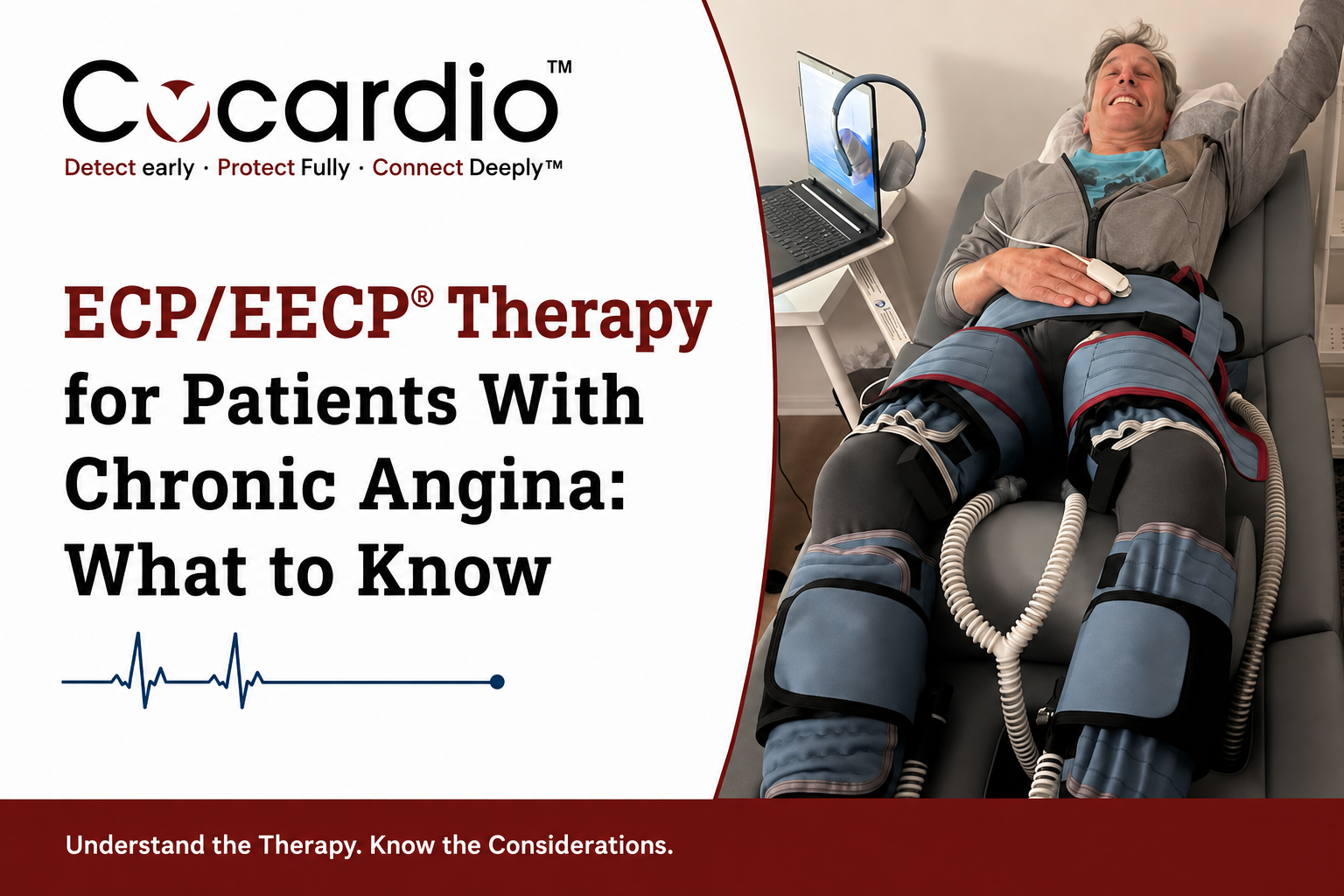
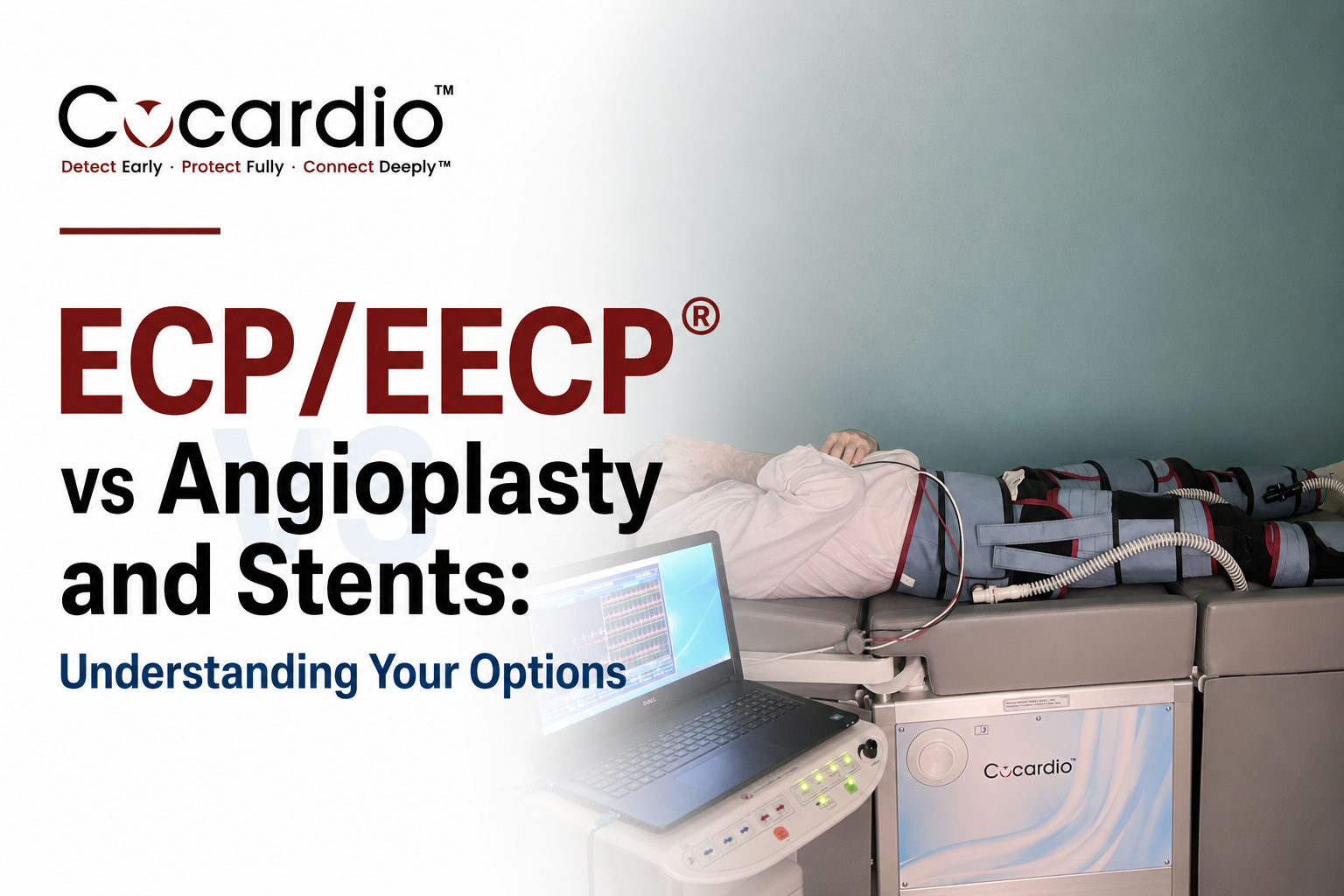
Enhanced External Counterpulsation, known as ECP or EECP®, is a noninvasive therapy delivered while you lie comfortably on a treatment table.
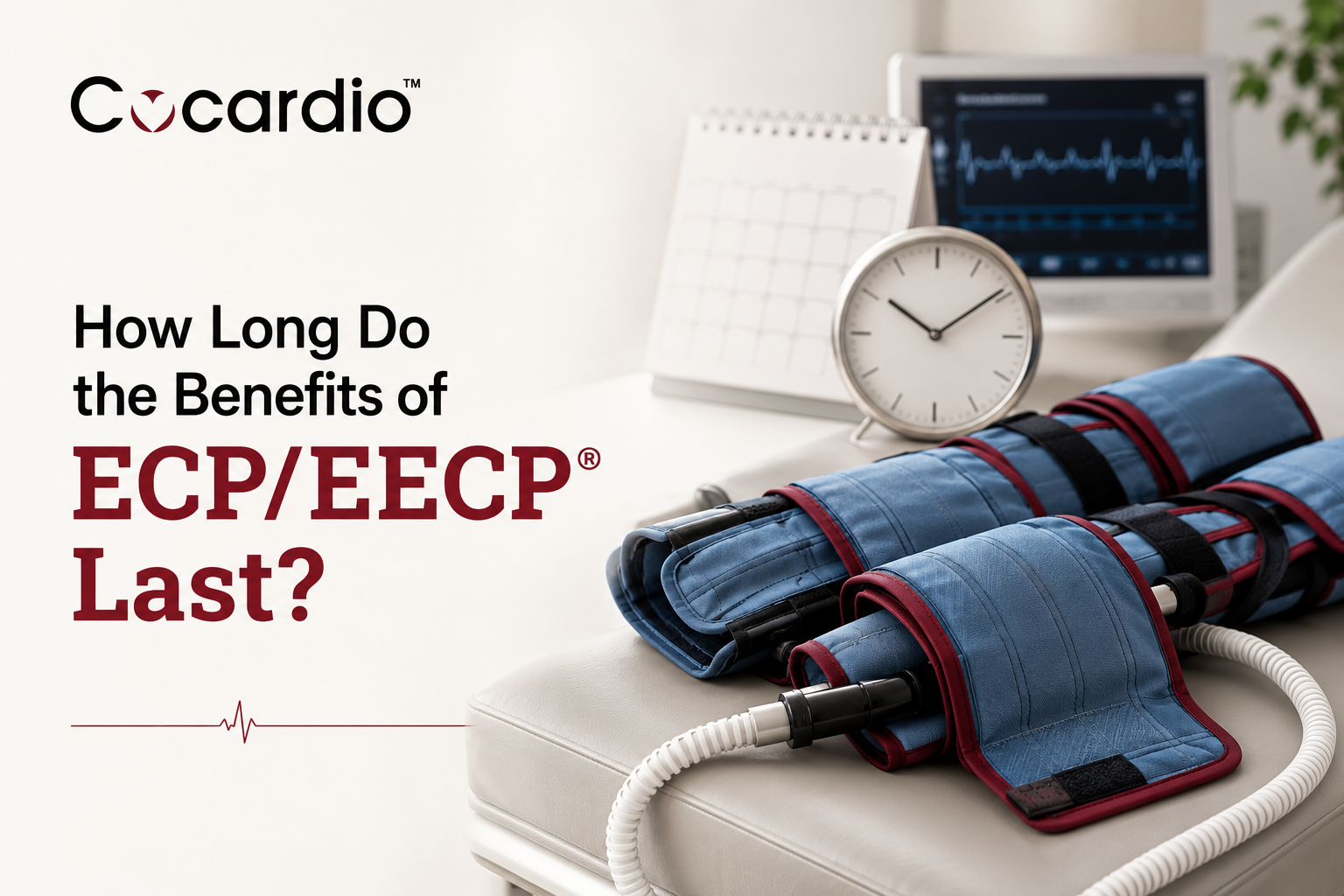
Inflatable cuffs are placed around the calves, thighs, and lower hips. The cuffs inflate and deflate in synchronization with your heartbeat using ECG timing.
During treatment, the sequential inflation of the cuffs is designed to support blood flow back toward the heart and improve circulation.
Unlike angioplasty or stenting, ECP does not involve:
- An incision
- A catheter inserted into an artery
- A balloon placed inside a coronary artery
- A stent
- Anesthesia
- A hospital stay
A typical ECP course involves multiple outpatient sessions over several weeks.
Research has evaluated ECP/EECP® in people with chronic stable angina, with studies reporting improvements in measures such as exercise capacity and angina symptoms in selected patients. However, the evidence for ECP is not equivalent to the evidence supporting coronary revascularization, and individual responses vary.
Most importantly:
ECP does not remove coronary plaque or physically open a blocked artery.
How They Differ: A Side-by-Side Comparison
The clearest way to understand these options is to see them side by side.
ECP/EECP® therapy does not replace medically indicated procedures.
This comparison is provided for educational purposes only and is not intended to recommend one treatment option over another. ECP/EECP® therapy should not be considered a substitute for angioplasty, stenting, bypass surgery, or any other procedure recommended by your cardiology team. Treatment decisions should be made in consultation with you and your qualified healthcare providers, based on your individual condition and needs.
| Angioplasty & Stents | ECP/EECP® Therapy | |
| What it is | A catheter-based medical procedure (PCI) that physically opens a narrowed or blocked coronary artery, usually placing a stent to hold it open | A noninvasive, session-based therapy using ECG-timed inflatable leg cuffs designed to support circulation |
| Invasiveness | Invasive; catheter inserted through a blood vessel | Noninvasive; no incisions, needles, catheters, or anesthesia |
| Setting | Hospital or catheterization lab | Outpatient sessions; you remain awake and return to daily activities afterward |
| When it is used | Can be urgent and lifesaving during a heart attack; also planned for significant symptomatic blockages | Never an emergency treatment; may be considered for chronic stable symptoms after appropriate screening |
| Typical course | A single procedure, with recovery and follow-up care | A series of sessions, commonly around one hour each, over several weeks |
| What it addresses | A specific blocked or narrowed artery segment | Broader circulatory support during the treatment series; does not open blockages or remove plaque |
| Who decides | You and your cardiology team, based on diagnostic testing | Considered only after consultation and screening, as an adjunct to your existing medical care |
| Role in your care | Established medical procedure within standard cardiology | Complements, rather than replaces, established medical care |
Disclaimer: ECP/EECP® therapy is not intended to replace angioplasty, stenting, bypass surgery, or any other medically recommended cardiac procedure. This article compares these options for educational purposes only and is not a recommendation to choose one over another. Decisions about angioplasty, stenting, or any procedure belong with you and the qualified medical professionals responsible for your cardiac care. CoCardio® does not advise declining or delaying a recommended procedure, and ECP/EECP® therapy is offered only as an adjunct to established medical care, following appropriate consultation and screening.
What ECP/EECP® Therapy Is Not
Because comparisons can sometimes create confusion, it is worth being very clear.
ECP/EECP® therapy:
- Does not remove coronary plaque
- Does not physically open a blocked coronary artery
- Does not replace a stent
- Does not replace bypass surgery
- Is not an emergency treatment for a heart attack
- Should not be used to delay or decline a medically recommended procedure
If your cardiology team has recommended angioplasty, stenting, bypass surgery, or another procedure, that recommendation deserves a thorough discussion with them.
At CoCardio®, we do not encourage patients to delay necessary medical care in favor of ECP.
For the right patient, however, ECP/EECP® may have a role as an additional, noninvasive component of a broader cardiovascular strategy.
How CoCardio® Looks at the Bigger Picture
At CoCardio®, we do not begin with a treatment. We begin by understanding you.
Every care journey starts with a Root Cause Consultation, where we consider your health history, current medical care, cardiovascular risk factors, lifestyle, and goals.
If you have already had a cardiac procedure, are being evaluated for one, or have been told you are not a candidate for one, that context matters. Your existing cardiac care remains central to any discussion about what may be appropriate.
When appropriate, your consultation findings may contribute to a Healthy Heart Blueprint™, our personalized framework for supporting cardiovascular health across the areas that matter most, including:
- Heart health and cardiovascular risk
- Metabolic health
- Diet and nutrition
- Movement and physical activity
- Sleep and stress
- Ongoing monitoring and medical follow-up
ECP/EECP® may be considered as one component of that broader strategy for appropriately screened individuals.
For eligible patients who have completed ECP and may benefit from additional treatment following reassessment, CoCardio® also offers the CoCardio Boost™ Program.
The goal is not to replace one treatment with another.
It is to understand the whole person, support informed decisions, and build cardiovascular care around what is appropriate for that individual.
Frequently Asked Questions
Can ECP/EECP® therapy replace angioplasty or stents?
No. Angioplasty and stenting are medical procedures that physically open blocked arteries, and decisions about them belong with you and your cardiology team. ECP/EECP® therapy is a noninvasive adjunct that may be considered alongside, never instead of, medically recommended care.
Should I try ECP therapy before agreeing to a stent?
It depends, and this decision should never be made without your cardiology team. The appropriateness and timing of a procedure depend on your diagnostic findings, symptoms, and overall picture, which your cardiologist is best positioned to evaluate. CoCardio® never advises delaying or declining a recommended procedure, and any exploration of ECP therapy should happen in the context of, not in place of, that medical guidance.
Can I do ECP therapy after having stents placed?
Some individuals who have undergone procedures later incorporate ECP therapy into a personalized cardiovascular wellness plan, following appropriate consultation and screening. Whether it is appropriate for you depends on your health history, current care, and evaluation findings.
What if I have been told I am not a candidate for stenting?
It depends on your individual situation. Some people with complex blockages who are not candidates for further procedures explore ECP/EECP® therapy as a noninvasive adjunct, alongside their continuing medical care. A consultation is the appropriate way to find out whether it may be considered in your case.
Is ECP/EECP® therapy safe compared to a procedure?
It depends, and the comparison itself can be misleading, because the two serve different purposes. ECP therapy is noninvasive and generally well tolerated by appropriately screened individuals, but it is not appropriate for everyone, and it does not accomplish what a procedure accomplishes. Safety, in both cases, is a question of appropriateness for the individual, which is what screening and medical evaluation exist to determine.
Does insurance cover ECP sessions at CoCardio®?
No. CoCardio® is a cash-pay practice. We do not bill insurance for consultations, ECP sessions, or preventive cardiovascular wellness services. Eligible HSA and FSA payments may be accepted. Patients should confirm eligibility requirements with their individual plan administrator.
The Real Question Is Not “Which One”
The most useful thing you can take from this article is a reframe. Angioplasty, stents, and ECP/EECP® therapy are not rivals on a menu. They are different tools with different purposes, and the question that matters is what your individual situation calls for, answered in partnership with the professionals who know your heart.
Your first step is a consultation so we can understand your health history, goals, current care, and whether CoCardio® services may be appropriate as part of your personalized cardiovascular wellness plan.
For your privacy, please do not share personal health information in public comments or unsecured messages. To discuss your individual situation, please contact our office directly through appropriate channels.
This article is provided for general educational purposes and does not constitute medical advice, diagnosis, or treatment. Individual circumstances vary, and decisions regarding cardiovascular care should be made with appropriate healthcare professionals.
CoCardio® services are designed to complement, not replace, emergency care, a cardiologist, primary care physician, cardiac rehabilitation program, prescribed medication, diagnostic testing, or medically recommended procedures.
If you have new, severe, or worsening symptoms, seek appropriate medical attention rather than relying on information provided in this article.
EECP® is a registered trademark of Vasomedical Inc., NY.