Introduction
Hearing the words “coronary artery disease” from a doctor changes the texture of an ordinary day. Maybe it followed a routine screening, a calcium score, a stress test, or an evaluation after symptoms. However it arrived, you likely left the appointment with two things: a diagnosis and a long list of questions.
This article is written for that moment. It explains what coronary artery disease actually is, in plain language, how it is diagnosed, what standard medical care typically involves, and where preventive cardiovascular wellness may fit alongside, never in place of, the care your medical team provides.
The goal is not to alarm you or to sell you anything. It is to help you understand your situation well enough to participate.
Important: New, severe, or worsening symptoms may require immediate medical attention. This article is for educational purposes and should not be used to evaluate urgent symptoms. New chest discomfort at rest, or discomfort that feels different from your usual pattern, warrants prompt medical evaluation. Call 911 if you think you may be having a medical emergency.
Quick Answer
Is a coronary artery disease diagnosis serious, and what can you do about it?
Yes, it is serious. And yes, you and your healthcare team can do a great deal about it.
Coronary artery disease, or CAD, means the arteries that supply blood to your heart muscle have narrowed, most often due to a gradual buildup of plaque.
Standard medical care may involve medications, procedures when recommended, cardiac rehabilitation, and lifestyle measures, all guided by your cardiologist and primary care team.
Alongside that care, preventive cardiovascular wellness may be incorporated as an adjunct following appropriate consultation. That includes education, lifestyle and stress support, coaching, and, for appropriately screened individuals, noninvasive options such as ECP/EECP® therapy.
A diagnosis is not the end of the story. For many people, it is the beginning of a far more informed and engaged relationship with their own heart.
What Is Coronary Artery Disease?
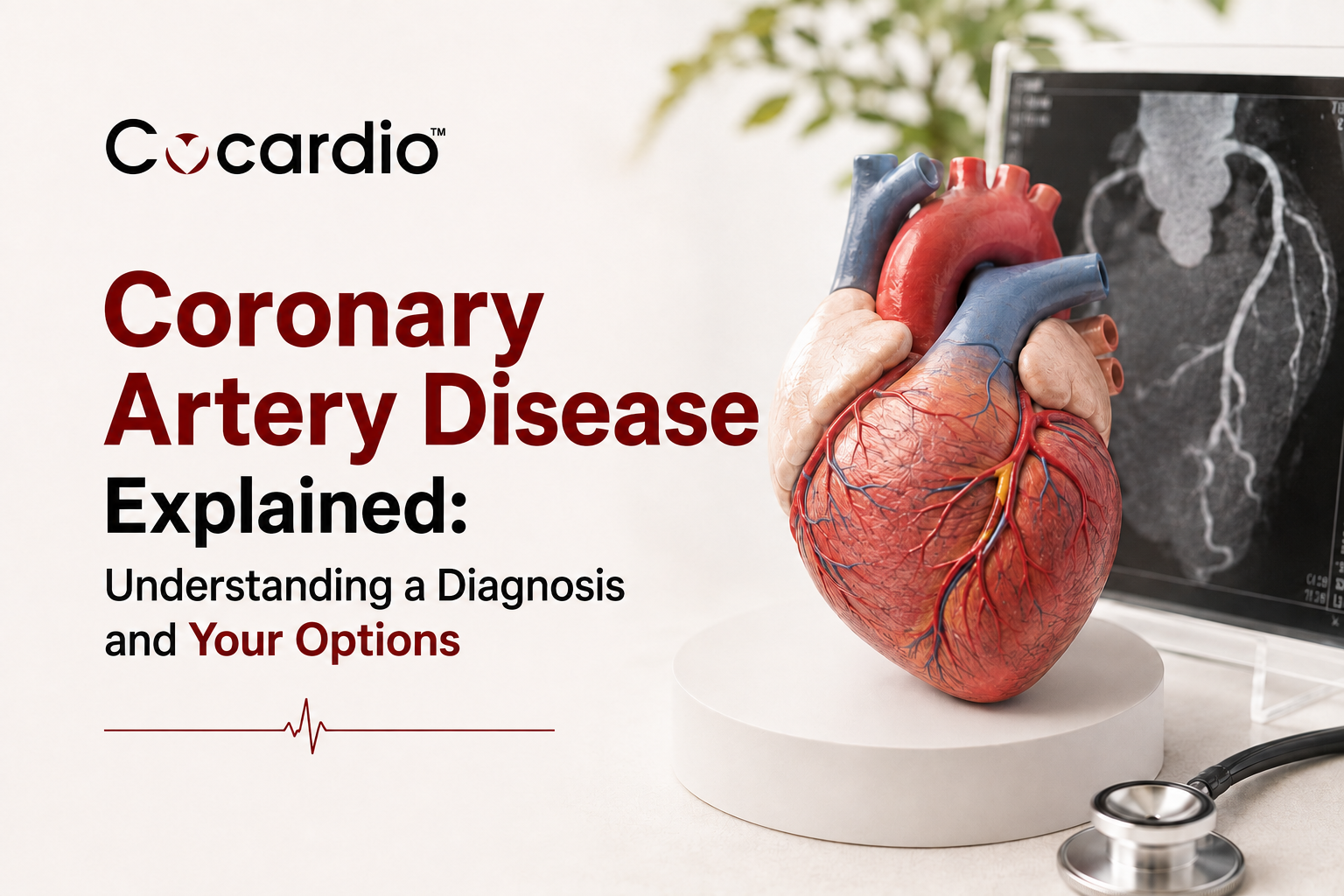
Your heart is a muscle, and like every muscle, it needs its own blood supply. That supply arrives through the coronary arteries, vessels that wrap around the heart and feed it oxygen-rich blood.
Coronary artery disease develops when those arteries narrow. The usual process is called atherosclerosis: a gradual buildup of plaque, a mixture of cholesterol, fats, calcium, and other substances, within the artery walls.
This typically unfolds over years or decades. Blood pressure, cholesterol, blood sugar, smoking, activity, nutrition, stress, sleep, family history, and age all play a part.
As the narrowing progresses, the heart muscle may not get all the blood flow it needs, especially during exertion or stress. That mismatch between demand and supply is what produces angina, the chest pressure, squeezing, or discomfort many people with CAD experience. Sometimes CAD is found before any symptoms appear, through screening such as a coronary calcium score.
Two truths sit side by side here. CAD is a serious, progressive condition that deserves consistent medical care. It is also one of the most studied conditions in all of medicine, with well-established treatments and a substantial role for the choices you make every day.
Common Symptoms of CAD
Symptoms vary depending on severity, and they may include:
- Chest pain or pressure, known as angina
- Shortness of breath with exertion
- Fatigue or low stamina
- Discomfort during physical activity
- Reduced exercise capacity
Some people have CAD without obvious symptoms, especially in the early stages. That is one reason early evaluation matters.
How Coronary Artery Disease Is Diagnosed
Your medical team may use several tools to understand your coronary arteries. Knowing what each one measures makes your results easier to discuss.
Coronary calcium scoring uses a CT scan to measure calcified plaque in the coronary arteries. It produces a score that reflects overall plaque burden and helps estimate risk, sometimes years before symptoms appear.
Stress testing, with or without imaging, looks at how your heart performs under exertion and whether areas of heart muscle get enough blood flow when demand rises.
Cardiac catheterization and angiography give a direct picture of the coronary arteries, showing where narrowing exists and how significant it is.
Newer Imaging Worth Knowing About
Cardiac imaging has moved fast in the last few years. These are the tools people now ask about by name.
Coronary CT angiography, or CCTA. This is a CT scan that shows the arteries themselves, not just calcium. It can pick up plaque that a calcium score would miss, including softer plaque.
The 2021 chest pain guideline from the American Heart Association and the American College of Cardiology gave coronary CTA a Class 1A recommendation for certain patients with chest pain.[1] The guideline calls it effective for diagnosing CAD, for sorting risk, and for guiding treatment decisions.[1]
FFR-CT. This is software that analyzes a CCTA scan. It estimates how much a narrowing actually restricts blood flow. That information used to require an invasive catheter procedure.
The same 2021 guideline gives FFR-CT a Class 2a recommendation for narrowings between 40% and 90%. It helps show whether a specific vessel is short of blood flow and helps guide decisions about whether a procedure is needed.[1] The best-known version, HeartFlow, was first cleared by the FDA in 2014.
AI-based plaque analysis. This is a newer category of software. It reads a CCTA scan and measures how much plaque is there and what kind it is. Tools in this space include HeartFlow’s plaque analysis and Cleerly. They describe plaque in more detail than a calcium score can.
Each test answers a different question. Your cardiologist picks and reads them against your whole picture. Availability varies by center, and not everyone needs every test.
Where CoCardio® comes in. These scans are ordered and interpreted by your medical team, not by us. What we add is time. A short appointment rarely leaves room to talk through what a result means for your daily life, or to look at the contributors sitting underneath it, such as inflammation, circulation, metabolic stress, and nervous-system balance. We keep up with these tools, and we make room for that longer conversation.
If you do not fully understand your results, ask your medical team to walk you through them. That is always a reasonable request. If you would also like an unhurried conversation about your broader picture and what you can work on between appointments, that is part of what we do.
What Standard Medical Care May Involve
Coronary artery disease care is well established. It is typically built from several elements your medical team may combine and adjust over time.
Medications may be prescribed to manage blood pressure and cholesterol, reduce the heart’s workload, relieve angina episodes, or lower the risk of clot-related events. Decisions about medications, including any changes, belong with the clinician who prescribes them.
Procedures, such as angioplasty with stenting or bypass surgery, may be recommended in certain situations to restore blood flow through significantly narrowed arteries. Whether and when a procedure is appropriate is decided between you and your cardiology team. In an emergency such as a heart attack, procedures can be lifesaving.
Cardiac rehabilitation is a structured, medically supervised program of exercise, education, and support, often recommended after a cardiac event, diagnosis, or procedure.
Lifestyle measures, including nutrition, physical activity, smoking cessation, sleep, and stress management, are foundational at every stage of CAD. They are also the area where your own daily participation matters most.
Nothing in preventive wellness replaces any of this. That statement is not fine print. It is the frame around everything that follows.
Living With CAD: The Long View
A coronary artery disease diagnosis reorganizes priorities, but it does not have to shrink a life. Many people live full, active decades with CAD, supported by consistent medical care and their own daily participation.
To understand where that participation matters most, it helps to think of coronary artery disease as having two phases.
The acute phase is the one medicine is built for. A heart attack. A hospitalization. An angioplasty or a stent. Emergency and interventional cardiology handle this phase extremely well, and nothing replaces it.
Then there is the phase that follows. You go home. The appointments spread out. The urgency fades. For many people, the day-to-day becomes something they handle largely on their own.
That second phase matters more than most people realize, because the underlying disease is still there.
Here is the part worth sitting with. The American Heart Association reports that about one in five people who have had a heart attack will be readmitted for a second one within five years. There are roughly 335,000 repeat heart attacks in the United States each year.[2] About a quarter of all heart attacks each year are repeat events.[3] A stent opens one artery. It does not remove the disease that narrowed it. Medication manages risk factors. It does not end the condition. Both are important, and neither is the whole answer.
This is the message that matters most, and it is easy to miss. Heart disease recurs. Having a procedure does not stop it from recurring. Being on medication does not stop it from recurring. Having good insurance does not stop it from recurring.
What keeps working, every day, in between everything else, is lifestyle. Nutrition, movement, sleep, stress, and consistency. Not for six weeks after the hospital, but as a long-term practice.
That is the gap where daily participation does its work. And it is where CoCardio® fits.
The people who navigate the long view best tend to share a few habits. They keep their appointments and take their care plan seriously. They ask questions until they understand their own condition. They treat lifestyle change as a long-term practice, not a short-term project. And they build a team rather than carrying it alone.
A diagnosis tells you what is. It does not, by itself, decide what comes next. That part involves you.
The CoCardio® Approach: Beyond the Diagnosis
At CoCardio®, we do not begin with a treatment. We begin by understanding you.
Every care journey starts with a Root Cause Consultation. It is a prevention-focused review of your health history, current medical care, risk factors, and goals. We look at contributors such as inflammation, circulation, metabolic stress, and nervous system balance, explained in plain language.
It is educational and advisory in nature. It does not establish a formal doctor-patient relationship, and it does not diagnose disease or prescribe treatment.
From there, a personalized plan may take shape. Depending on your picture and following appropriate screening, it may include:
- Lifestyle and nutrition support
- Stress reduction and nervous-system regulation, including a coaching program in which we teach methods to support vagal tone
- Coaching, one-on-one or in a group, including an online coaching membership, so the months between appointments are supported rather than solitary
- Structured guidance such as the Healthy Heart Blueprint™
- For appropriately screened individuals with conditions such as chronic stable angina, noninvasive ECP/EECP® therapy is offered as part of the CoCardio Boost™ Program
The common thread is continuity. Standard care is strongest at the moment of crisis. The years afterward are where consistency decides a great deal. That is also the stretch where most people have the least support.
Every element serves the same purpose. It helps you become a more informed, engaged, and proactive participant in your own heart health, alongside the medical care you already receive.
Once emergency conditions have been ruled out by your medical team, our focus turns to understanding circulation, reducing risk, and supporting quality of life over the long run. Our role is supportive, consultative, and educational. It is not procedural.
Heart function testing, also known as an echocardiogram, is often part of that picture. It is a noninvasive ultrasound that looks at pumping strength, valve function, and areas of strain, and it gives you a baseline to track over time.
CoCardio Boost™ (ECP) for CAD Support
For individuals with stable coronary artery disease, CoCardio Boost™, our external counterpulsation program, may be an appropriate noninvasive option.
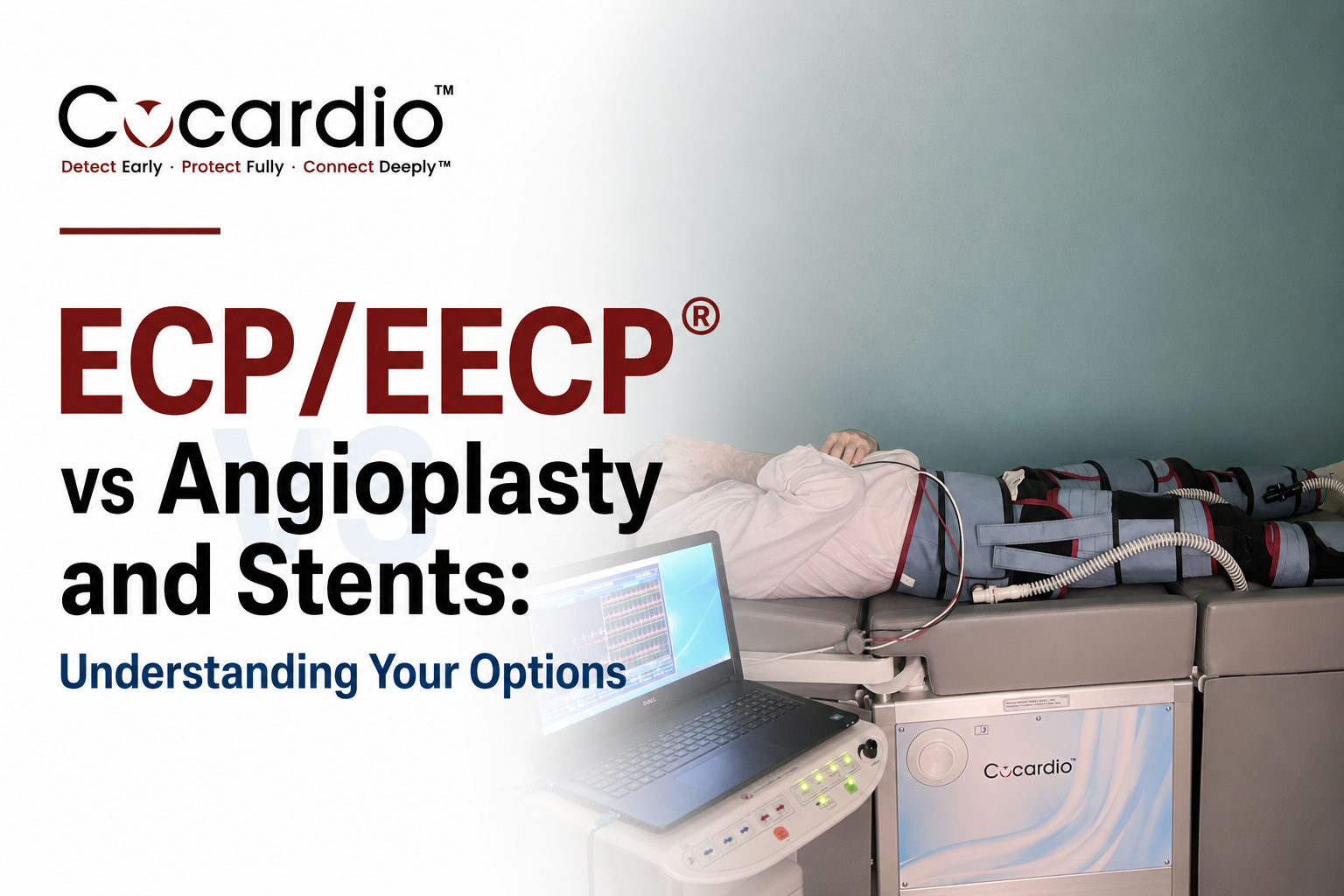
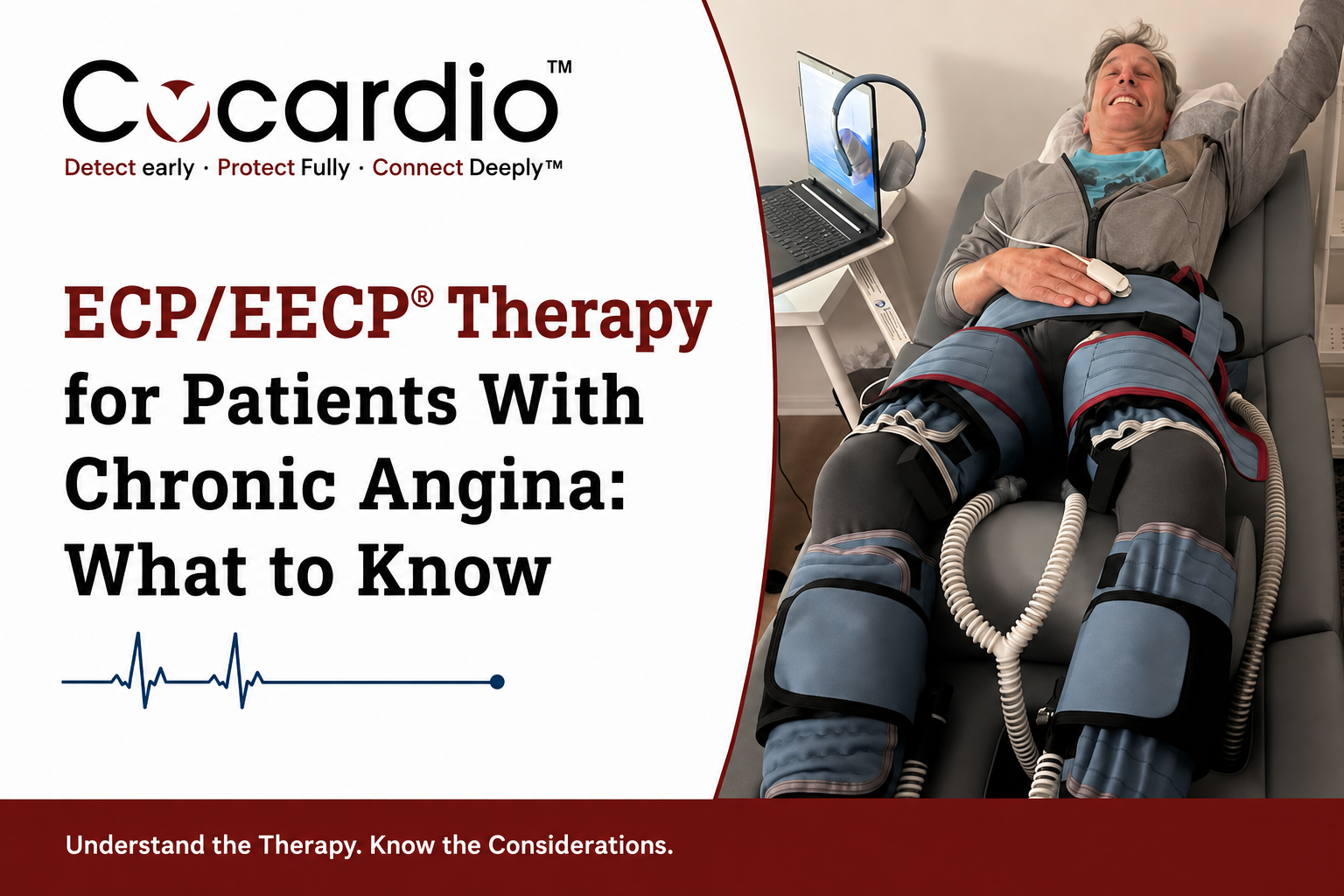
ECP is a noninvasive therapy. Cuffs around the lower body inflate and deflate in time with the heartbeat, guided by your ECG. There are no cuts, no anesthesia, and no hospital stay.
It has been widely studied in people with chronic stable angina. In that research, appropriately selected patients have reported:
- Less frequent angina
- Better exercise tolerance
- Less need for short-acting nitrate medication
- Improved quality of life
Researchers have proposed several mechanisms for these reported effects, including improved blood flow to the heart muscle and the development of collateral circulation. Much about how the benefits arise is still being studied, and individual responses vary.
What ECP Does Not Do
This part matters as much as the rest.
ECP does not remove plaque. It does not cure CAD. It is not a substitute for prescribed medication, and it does not replace angioplasty, bypass surgery, or any other medically necessary procedure. It is never a treatment for emergency symptoms.
At CoCardio®, ECP is one potential tool within a broader strategy, not the strategy itself. It sits alongside your medical care, never in place of it.
Who May Be a Candidate
Candidacy is determined carefully, through consultation and appropriate screening, which may include heart function testing.
It may be worth exploring if you have been diagnosed with CAD, experience angina or reduced exercise tolerance, or want noninvasive options alongside your cardiology care. We serve Encinitas and the greater San Diego area.
Who This Is Not For
This is equally important.
CoCardio Boost™ is not appropriate if you are experiencing active or severe chest pain, if you require emergency or interventional cardiac care, or if you are seeking an immediate procedure or surgical treatment.
In urgent situations, immediate medical care is essential. Call 911 if you think you may be having a medical emergency.
Cost and Payment
CoCardio® is a cash-pay practice. We do not bill insurance for consultations, ECP sessions, or preventive cardiovascular wellness services. Eligible HSA and FSA payments may be accepted. Please confirm eligibility with your plan administrator.
Frequently Asked Questions
Can coronary artery disease be cured?
No. CAD is a chronic condition, and no therapy, conventional or preventive, has been shown to cure it. What is well established is that consistent medical care and sustained lifestyle participation can meaningfully influence symptoms, quality of life, and long-term risk.
If I have had a stent, am I fixed?
No. A stent restores blood flow through one narrowed artery. The underlying disease remains, which is why ongoing care, monitoring, and risk management continue afterward. According to the American Heart Association, about one in five heart attack survivors is readmitted for a second one within five years.
What is a coronary CT angiogram, and how is it different from a calcium score?
It depends on what is being looked for. A calcium score measures calcified plaque and produces a risk estimate. A coronary CT angiogram shows the arteries themselves, including plaque a calcium score may miss. Which test suits you is a decision for your cardiology team.
Do I still need my cardiologist if I start a preventive wellness program?
Yes, absolutely. Preventive wellness is an adjunct to cardiac care, never a replacement. Your cardiologist remains central to your diagnosis, treatment, and monitoring.
Can ECP/EECP® therapy help with coronary artery disease?
It depends. ECP/EECP® has been studied for decades in people with chronic stable angina related to CAD, with many appropriately selected patients reporting reduced symptoms and better activity tolerance. It does not remove plaque or cure the disease, it is not right for everyone, and it may be considered only after appropriate consultation and screening.
Should I go to a doctor right away if my symptoms change?
Yes. New, severe, or worsening chest discomfort, symptoms at rest, unusual shortness of breath, or anything that feels different from your usual pattern needs prompt medical attention. When in doubt, seek care. Emergency evaluation is never an overreaction.
Does insurance cover services at CoCardio®?
No. CoCardio® is a cash-pay practice. We do not bill insurance for consultations, ECP sessions, or preventive cardiovascular wellness services. Eligible HSA and FSA payments may be accepted. Please confirm eligibility with your plan administrator.
Understanding Is the First Intervention
The most powerful early response to a coronary artery disease diagnosis is not a product or a program. It is understanding: of your condition, your numbers, your care, and your own role in what happens next.
Your first step is a consultation so we can understand your health history, goals, current care, and whether CoCardio® services may be appropriate as part of your personalized cardiovascular wellness plan.
For your privacy, please do not share personal health information in public comments or unsecured messages. To discuss your situation, please contact our office directly through appropriate channels.
References
- Gulati M, Levy PD, Mukherjee D, et al. 2021 AHA/ACC/ASE/CHEST/SAEM/SCCT/SCMR Guideline for the Evaluation and Diagnosis of Chest Pain: A Report of the American College of Cardiology/American Heart Association Joint Committee on Clinical Practice Guidelines. Circulation. 2021;144(22):e368-e454. doi:10.1161/CIR.0000000000001029.
- American Heart Association. Proactive steps can reduce chances of second heart attack. American Heart Association News.
- American Heart Association. Heart attack statistics, cited in: Dangers of life-threatening second heart attack may be highest soon after the first. American Heart Association News, August 2021.
This article is provided for general educational purposes and does not constitute medical advice, diagnosis, or treatment. Individual circumstances vary, and decisions regarding cardiovascular care should be made with appropriate healthcare professionals.
CoCardio® services are designed to complement, not replace, emergency care, a cardiologist, primary care physician, cardiac rehabilitation program, prescribed medication, diagnostic testing, or medically recommended procedures.
If you have new, severe, or worsening symptoms, seek appropriate medical attention rather than relying on information provided in this article.
EECP® is a registered trademark of Vasomedical Inc., NY. HeartFlow and Cleerly are trademarks of their respective owners.