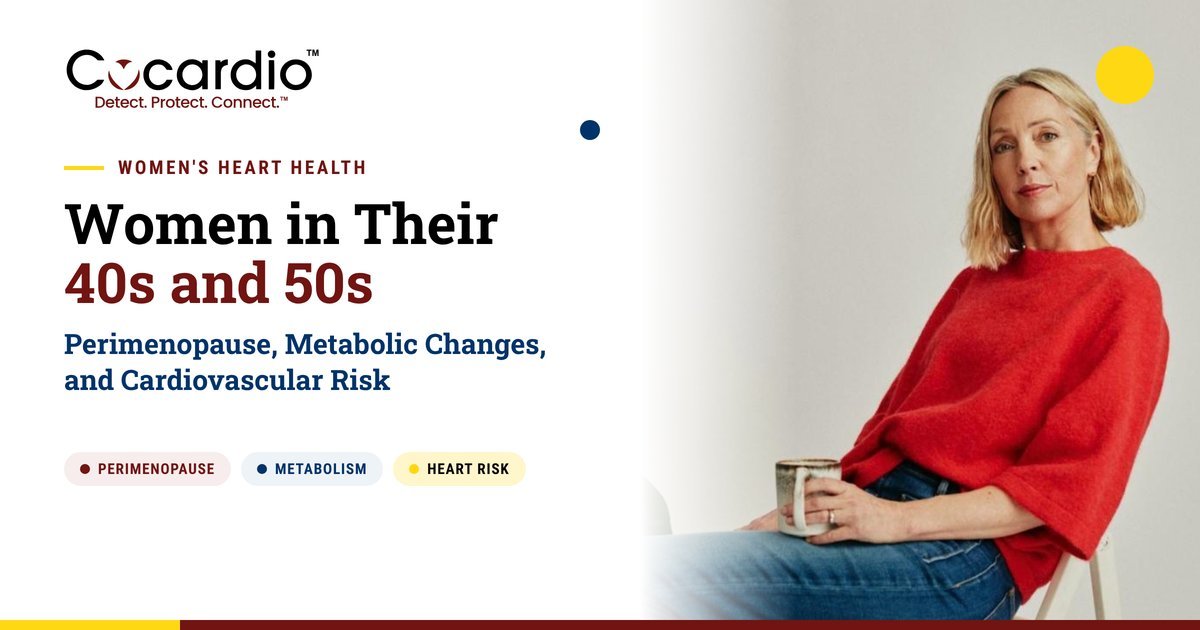
It Happens in About Two Years, Not Twenty
Most writing about menopause and cardiovascular risk is vague about timing. One study was not.
The Study of Women’s Health Across the Nation measured 3,302 women every year. In the 1,054 who reached a natural final period without hormone therapy or surgery, one question could be asked cleanly. Are the changes in midlife women caused by aging, or by the transition itself?
For cholesterol, the answer was the transition, and the timing was narrow. LDL rose at roughly three times its earlier rate in the year before and the year after the final period. Apolipoprotein B, which counts the particles that lodge in artery walls, accelerated against its own earlier pace by close to five times. Then both went flat.
So this is not a slow slide across a decade. For lipids, it is a window about two years wide, the tightest of the changes here. Routine screening is not timed to the final period, so most women have no measurement close on each side of it.
Important: This article is for educational purposes and cannot interpret your results. New, worsening, or persistent chest discomfort needs prompt medical attention. Call 911 if you think you may be having an emergency.
What Actually Changes, and What Does Not
Much written on this is too sweeping. The useful version separates what the transition moves from what moves with age.
Cholesterol and particle count change with the transition. Total cholesterol, LDL, and ApoB all showed the sharp, brief rise described above. Higher cholesterol after menopause is the clearest menopause-specific signal in the research.
Blood pressure, blood sugar, and triglycerides show no menopause signal. In the same cohort, triglycerides and insulin climbed gradually year by year, systolic blood pressure crept up by a fraction of a point annually, and fasting glucose showed no jump at the final period. These numbers still matter. They are just not evidence of a menopause effect.
Your body composition changes while the scale behaves normally. This is the finding patients are least often told. In the same cohort, fat gain roughly doubled, from about 1 percent a year to 1.7 percent, while lean mass switched from slowly gaining to slowly losing. The rate of weight gain itself did not change. The scale keeps doing what it always did, and tells you less.
Visceral fat moves before your periods stop. Imaging work in the same study found abdominal visceral fat rising roughly 8 percent a year through the transition, with the steep part beginning about two years before the final period. Every 20 percent rise went with measurably thicker carotid artery walls, whatever the woman weighed.
These markers help us identify where we may be able to reduce risk.
What These Changes May Mean
Perimenopause heart health is where the signal shows up
A study published in May 2026 scored more than 9,000 American women on the American Heart Association’s eight measures of cardiovascular health. Adjusted for age, perimenopausal women were about twice as likely as premenopausal women to have a poor overall score, and worse on cholesterol and blood sugar.
The perimenopausal group was the smallest of the three and the range around that figure was wide, so the exact number is soft. The direction is what matters, and the senior author called perimenopause a “window of opportunity.”
Frequent hot flashes may carry information
Women who report hot flashes and night sweats in midlife have gone on to have somewhat more cardiovascular events, with the clearest link for severe or persistent symptoms.
Read this as a signal, not a cause. No trial has shown that treating hot flashes lowers cardiovascular risk.
Your reproductive history is part of your cardiovascular history
Going through menopause early raises later risk, and the effect is graded. Pooled data on more than 300,000 women found risk rising as the age at menopause fell, with the largest effect before 40. For events before 60 it was stronger still.
Pregnancy counts too. Preeclampsia roughly doubles the risk of coronary heart disease. Gestational diabetes carries a similar signal, smaller but still there in women who never develop diabetes. The 2026 ACC/AHA dyslipidemia guideline names these and early menopause as reproductive risk markers. It asks that the history form part of routine assessment.
What It Does NOT Necessarily Mean
- It does not mean your risk jumps off a cliff, since death rates from heart disease rise steadily with age without a step at the transition
- It does not mean hormone therapy is a heart treatment, because it is not prescribed for that and the evidence does not support it
- It does not mean your symptoms would be unusual. Chest pain is the most common heart attack symptom in women and men alike, and women are also likelier to have other signs with it or instead of it: shortness of breath, nausea, jaw, neck, or back pain, lightheadedness, and unusual fatigue. Any of those, especially if sudden or together, warrants emergency care, not waiting
The goal is to understand your complete cardiovascular picture.
Questions to Discuss With Your Physician
These five are worth taking with you.
- Can we check my lipids and ApoB now, so there is a before to compare against later?
- What does my risk look like over 30 years rather than 10?
- I went through menopause at the age I did. Does that change what we do?
- My pregnancies involved complications. Should those be on my record as cardiovascular risk factors?
- Would a calcium score change any decision we are making?
The second matters most. A woman of 48 almost always has a low ten-year risk, which can end a conversation that should have continued.
What Actually Helps
Get a baseline before the window closes. This is the most useful thing here. Lipids and ApoB measured in your early forties make the change through the transition visible. A first measurement at 55 does not. Whether acting earlier changes outcomes has not been tested in a trial, which is worth knowing.
Ask for the 30-year estimate. The PREVENT equations, now recommended in the 2025 blood pressure guideline and the 2026 cholesterol guideline, are sex-specific and report both a 10-year and a 30-year risk. For a woman in her forties, the second number is the one that tells her something.
Measure your waist, and protect your muscle. With fat rising and lean mass falling, the scale is the wrong instrument and a tape measure catches what it misses. Resistance training twice a week aims at the measurement that actually moved.
Treat sleep as a cardiovascular matter. Sleep scored highest of the eight measures in 2026, but that score counts hours rather than quality, a limitation the authors flag. Heart rate variability responds to sleep and stress, so it gives feedback faster than an annual panel.
Have your reproductive history written down. Age at menopause, and any preeclampsia, gestational diabetes, or preterm delivery. No risk calculator takes it as an input. It tells your physician how hard to push on the numbers that can be moved.
Medication may be one part of the strategy. Lifestyle and metabolic optimization remain important regardless.
When Further Cardiovascular Assessment May Be Appropriate
Coronary artery calcium scoring. The 2026 guideline says a calcium score can be useful in women aged 45 and older at borderline or intermediate risk, where the result would change a treatment decision. It reports how much calcified plaque has already built up, not how much might build up later. It does not see every kind of plaque.
ApoB alongside your cholesterol panel. ApoB is one of the markers that move with the transition. Counting particles, rather than the cholesterol they carry, gives a clearer read.
Lipoprotein(a), with one complication. The 2026 guideline says to measure lipoprotein(a) at least once, since it is largely genetic and stable. The menopause evidence sits slightly against that, with population data suggesting levels run roughly a quarter higher afterward. Separating that from aging has proved difficult, so it is worth raising.
Metabolic markers. HbA1c and fasting insulin speak to the insulin resistance sitting under several of the other numbers.
Each of these may be discussed with your physician, who decides what is appropriate for you. A complete cardiovascular risk assessment draws on several measures rather than one.
Where CoCardio® Fits
Detect Early. Protect Fully. Connect Deeply.
In October 2026 four medical societies published the first shared framework for women’s cardiovascular care across life, treating menstrual and reproductive history as early markers of heart risk. They also describe care most appointments are too short to deliver.
That gap is where a longer conversation pays for itself. The Root Cause Consultation, with Dr Pratiksha G Gandhi MD, Preventive Heartcare Expert, reviews your health history, your current medical care, your prior testing, your reproductive history, and your family history. Then we work through the whole picture rather than one marker.
Positioning, stated plainly. Medication is one tool. The bigger opportunity is understanding your actual cardiovascular risk and building a comprehensive prevention plan around it. This article is not anti-statin and not anti-medication.
Boundary. CoCardio® never advises starting, stopping, or changing prescribed medication, including hormone therapy. Those decisions stay with the physician who prescribed it.
Bring your results to CoCardio® for a preventive cardiovascular review and a personalized action plan.
For your privacy, please share results only through our secure booking and intake process, and do not share personal health information in public comments or unsecured messages.
Frequently Asked Questions
Does hormone therapy protect my heart?
No. Hormone therapy is not prescribed to protect the heart, and the US Preventive Services Task Force recommends against using it to prevent chronic conditions, having found no net benefit. That recommendation covers prevention only. It does not apply to women considering hormone therapy for hot flashes or other symptoms, which The Menopause Society describes as the most effective treatment available, nor to women who went through premature or surgical menopause. Whether it suits you is a conversation for the physician who would prescribe it.
Did the FDA decide hormone therapy is safe for the heart?
No. On November 10, 2025, the FDA began removing cardiovascular, breast cancer, and dementia language from the boxed warning, and the first updated labels were approved on February 12, 2026. No heart-protection indication was added.
Does menopause increase heart disease risk?
It depends on which part you mean. Total cholesterol, LDL, and ApoB rise sharply in the year on either side of the final period, in a way aging does not explain. Blood pressure and blood sugar show no comparable jump, and death rates from heart disease do not step up at menopause. So specific numbers move, which is worth measuring. A cliff does not arrive.
I went through menopause at 44. Should I be doing anything differently?
Yes, in the sense that it belongs on your record. Menopause before 45 is associated with higher later cardiovascular risk, more so before 40, and the current guideline names it as a risk marker. It does not mean anything is wrong now. It means the threshold for looking closely is lower.
My ten-year risk came back low. Is that reassuring?
It depends on what you do with it. A low ten-year number in your forties is expected and says little about the decades after. Ask for the 30-year estimate, and ask whether your reproductive history was counted, since no calculator asks about it.
Will losing weight fix this?
It depends on what is changing. In the research, weight kept rising at the rate it already was, without accelerating. What changed was the composition: more fat, less muscle, on the same weight trajectory. So waist measurement and preserved muscle are better targets than the scale.
Sources
- Are Changes in Cardiovascular Disease Risk Factors in Midlife Women Due to Chronological Aging or to the Menopausal Transition?, the Study of Women’s Health Across the Nation, Journal of the American College of Cardiology, 2009.
- Changes in body composition and weight during the menopause transition, JCI Insight, 2019.
- Abdominal visceral adipose tissue over the menopause transition and carotid atherosclerosis, SWAN Heart, Menopause, 2021.
- Cardiovascular health characterization using Life’s Essential 8 score in perimenopausal women, Journal of the American Heart Association, 2026.
- Vasomotor menopausal symptoms and risk of cardiovascular disease, a pooled analysis of six prospective studies, American Journal of Obstetrics and Gynecology, 2020.
- Age at natural menopause and risk of incident cardiovascular disease, a pooled analysis, Lancet Public Health, 2019.
- Pre-eclampsia and risk of cardiovascular disease and cancer in later life, BMJ, 2007.
- Gestational diabetes and risk of cardiovascular disease, Diabetologia, 2019.
- Sex differences of lipoprotein(a) levels and associated risk of morbidity and mortality by age, the Copenhagen General Population Study, Atherosclerosis, 2022.
- 2026 ACC/AHA/Multisociety Guideline on the Management of Dyslipidemia, JACC, March 2026.
- Development and Validation of the American Heart Association’s PREVENT Equations, Circulation, 2024.
- A Female-Specific Life Course Approach to the Prevention and Management of Cardiovascular Disease, a Presidential Advisory From the American Heart Association, American Academy of Pediatrics, American College of Obstetricians and Gynecologists, and Society for Maternal-Fetal Medicine, Circulation, October 26, 2026.
- Hormone Therapy for the Primary Prevention of Chronic Conditions in Postmenopausal Persons, US Preventive Services Task Force, JAMA, 2022.
- The 2022 Hormone Therapy Position Statement of The North American Menopause Society, Menopause, 2022.
- FDA labeling change requests of November 10, 2025, and approvals of February 12, 2026.
Medical Disclaimer
This article is provided for general educational purposes and does not constitute medical advice, diagnosis, or treatment. Individual circumstances vary, and decisions regarding cardiovascular care should be made with appropriate healthcare professionals.
CoCardio® services are designed to complement, not replace, emergency care, a cardiologist, primary care physician, cardiac rehabilitation program, prescribed medication, diagnostic testing, or medically recommended procedures.
If you have new, severe, or worsening symptoms, seek appropriate medical attention rather than relying on information provided in this article.