When Your Body’s Automatic Settings Stop Working the Way They Should
Your heart beats about 100,000 times a day. You never think about it. You do not tell your heart to speed up when you climb stairs, or to slow down when you sit and rest. Something else handles that for you.
That something is your autonomic nervous system.
Most of the time it works quietly in the background. But for some people, it stops working the way it should. Doctors call this autonomic nervous system dysfunction. It is a real, studied part of medicine. And it can affect the heart in ways many people have never heard about.
This article explains what the autonomic nervous system does. It covers what happens when the system does not work well, and how that connects to heart health. We will also look at what standard medical care may involve. And we will look at where preventive cardiovascular wellness may fit alongside that care.
Important: This article is for educational purposes and should not be used to evaluate urgent symptoms. New, worsening, or persistent chest discomfort, especially discomfort at rest, may need emergency medical attention. Fainting, a racing heart that will not settle, or sudden severe symptoms also need prompt medical care. Call 911 if you think you may be having a medical emergency.
Quick Answer
Can autonomic nervous system dysfunction affect your heart?
Yes. The autonomic nervous system helps control your heart rate, your blood pressure, and how your body responds to stress. When it does not work the way it should, people may notice symptoms such as a racing or uneven heartbeat, dizziness when standing, blood pressure that swings, poor sleep, or fatigue.
Autonomic dysfunction is a medical issue. A qualified healthcare professional should evaluate and diagnose it. An article cannot, and neither can a self-check.
Some people also choose to work on the daily factors that affect this system. Stress. Sleep. Activity. Breathing. At CoCardio®, that work may be part of a personalized cardiovascular wellness plan, following a proper consultation and screening. It serves as an adjunct to cardiac care. It complements, rather than replaces, your cardiologist, your primary care physician, prescribed medications, or any recommended testing or treatment.
What Does the Autonomic Nervous System Do?
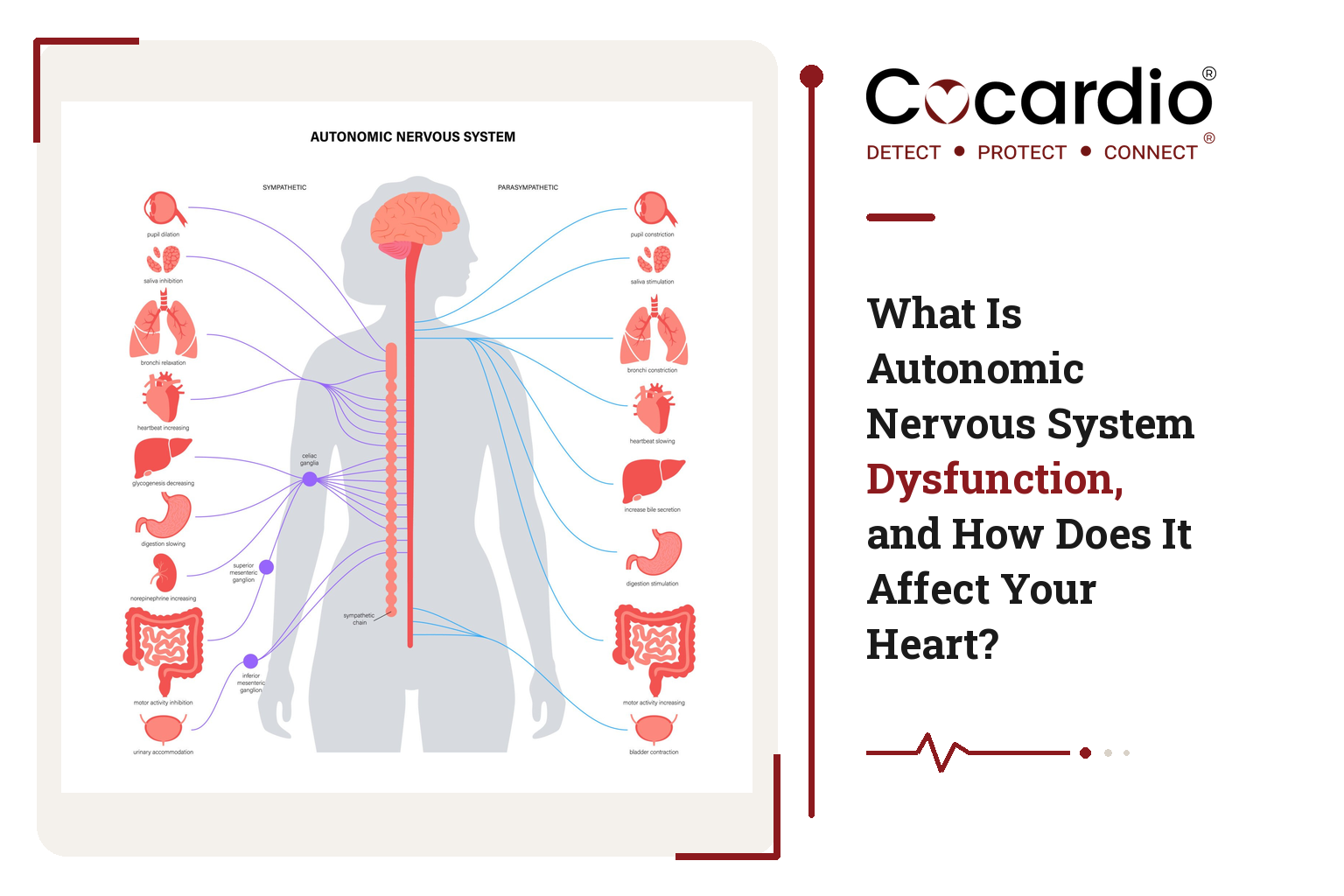
Think of it as your body’s automatic control system. It runs the jobs you never have to think about. Your heartbeat. Your blood pressure. Your breathing. Your digestion. Even your body temperature.
It has two main branches, and they work as a pair.
The sympathetic branch is your “go” system. It speeds the heart up, raises blood pressure, and gets you ready for effort or stress. Most people know it as the fight-or-flight response.
The parasympathetic branch is your “recover” system. It slows the heart down, supports digestion, and helps the body rest and repair.
Neither branch is good or bad. What matters is the balance between them. It also matters how well your body shifts from one to the other as your day changes. A body that can speed up when needed, then settle back down, is doing exactly what it should.
What Is Autonomic Nervous System Dysfunction?
Autonomic dysfunction, also called dysautonomia, is a broad term. It covers what happens when this system does not respond the way it should.
Sometimes the “go” side stays switched on too long. Sometimes the “recover” side does not come back strongly enough. Sometimes the shift between the two is slow or unreliable.
Autonomic dysfunction is not one single disease. It is a pattern that shows up in many different situations. It can be linked to diabetes, to some nerve conditions, to certain infections and illnesses, and to some medicines. Long-term stress, poor sleep, and other daily factors can play a part too.
Because the causes vary so much, evaluation matters. Only a qualified healthcare professional can look at your history, your symptoms, and your test results and say what is going on in your case.
Autonomic Dysfunction and the Heart: How It Can Affect You
The link between the autonomic nervous system and blood pressure runs both ways, and the same is true for heart rate. This system has a direct line to the heart and blood vessels. So when it is not working well, the heart is often where people notice it first.
Some people with autonomic dysfunction report:
- A heart that races, pounds, or feels uneven
- Dizziness or lightheadedness when standing up
- Blood pressure that rises and falls more than expected
- Feeling wired at night and tired during the day
- Poor sleep and slow recovery after activity
- Fatigue that rest does not fix
- Symptoms that flare during stressful moments
Here is the part many people find surprising. The connection between stress and heart health is not just a saying. Stress creates real, measurable changes in heart rate and blood pressure through this system. That is why some people notice symptoms during a hard phone call, not just during exercise.
It is important to be clear about two things.
First, these symptoms have many possible causes. Having them does not mean you have autonomic dysfunction. Many of them can also point to other conditions that need prompt medical care.
Second, this article cannot tell you whether you have autonomic nervous system dysfunction. Only appropriate medical evaluation can do that.
What About Heart Rate Variability?
You may have seen heart rate variability, or HRV, on a smartwatch or fitness tracker.
HRV measures the small gaps in time between one heartbeat and the next. Those gaps are shaped by the autonomic nervous system. So HRV is often used as one window into how that system is working.
Research on HRV is still developing. Expert guidance has noted that its established clinical uses are fairly narrow, and that measurement methods matter a great deal.[1] It is one sign among many, and no single number tells the whole story about anyone’s heart health. Consumer devices also vary in how they measure it.
So HRV can be useful information. It is not a diagnosis. And it should not take the place of a talk with a healthcare professional who knows your situation.
What Standard Medical Care May Involve
If a doctor suspects autonomic dysfunction, the approach depends on the person and the likely cause. Care may include:
- A full history and physical exam
- Blood pressure and heart rate measurements in different positions
- Heart rhythm monitoring or other cardiac testing
- Blood work to look for related conditions
- Specialist referral, such as to a cardiologist or neurologist
- Treating an underlying condition that may be contributing
- Reviewing medications that can affect blood pressure or heart rate
- Guidance on hydration, salt, activity, or other daily measures
These decisions belong with your medical team. CoCardio® never advises anyone to start, stop, or change prescribed medication. And nothing in preventive wellness replaces this kind of evaluation.
What Does “Autonomic Reset” Actually Mean?
You may come across the phrase “autonomic reset.” It is worth explaining plainly, because the wording can suggest more than it should.
There is no switch that resets your nervous system. The phrase is shorthand for something simpler: working on the daily inputs that influence how your body shifts between its “go” and “recover” states.
In practice, that usually means structured breathing practices, stress management, better sleep habits, supervised activity, and nutrition. None of these are procedures. None of them are treatments for a diagnosed autonomic disorder. They are habits and practices, and like all habits, they depend on consistency and on the person doing them.
Research in this area is still developing. Breathing and stress practices have been studied for their effects on heart rate and blood pressure, but how much any one person benefits varies, and no responsible provider can promise a specific result.
So here is the honest version. Supporting your nervous system through daily habits is a reasonable, low-risk thing to work on alongside your medical care. It is not a substitute for evaluation, diagnosis, or treatment by a qualified healthcare professional, and it does not reset, cure, or fix anything on its own.
The Part Nobody Asks About
Here is something worth noticing. In a standard cardiac appointment, your blood pressure gets checked. Your cholesterol gets checked. Your medications get reviewed.
Your nervous system usually does not come up at all.
That is not because medicine rejects the idea. Stress management appears in prevention guidelines as a lifestyle measure. The practical issue is time. A short appointment has a lot to cover, and structured work on breathing, stress, and recovery rarely makes the list.
CoCardio® runs a Nervous System Reset Program, offered one-on-one or in group coaching. The name uses “reset” the way most people do, as shorthand. What it actually involves is teaching practices intended to support vagal tone, meaning the activity of the vagus nerve, the main pathway of the “recover” branch described earlier.
These are habits and practices, not procedures. They are taught over time; how much any one person benefits varies, and they are not a treatment for a diagnosed autonomic disorder.
Where Preventive Cardiovascular Wellness May Fit
At CoCardio®, we do not begin with a treatment. We begin by understanding you.
Every care journey starts with a consultation. Our team reviews your health history and your current medical care. We look at your symptoms and their pattern, your goals, and the safety issues that matter for you. The consultation is not an unnecessary step. It is how we understand the person behind the health concern and decide the most appropriate next step. It also helps us see when we should coordinate with your existing healthcare professionals.
For some people, and only following appropriate evaluation and screening, a personalized plan may include support in the areas that affect this system every day:
- Structured breathing practices
- Stress management and meditation
- Sleep habits
- Supervised exercise and daily activity
- Nutrition guidance
- The Nervous System Reset Program, offered one-on-one or in group coaching
CoCardio® also runs a coaching program, available one-on-one or in a group, where we teach methods intended to support vagal tone. Vagal tone refers to the activity of the vagus nerve, the main pathway of the “recover” branch described earlier. These are practices, not procedures. They are taught as habits you build over time, and how much any one person benefits varies.
Depending on your picture, that work may be organized through the Healthy Heart Blueprint™. It is a personalized roadmap designed to help you better understand your cardiovascular wellness goals, current health considerations, and possible next steps.
We want to be direct about what this is and is not. This is professional education and support. It aims to help you take an active part in your heart wellness. It is not a treatment for a diagnosed autonomic disorder. And it does not replace evaluation or treatment from a qualified medical professional.
CoCardio® may be a strong fit for people who want to take a proactive role in their heart wellness. It suits people who value personal attention and education, and who are open to working alongside their existing healthcare team. It may not be the right fit for someone who wants a predetermined recommendation without completing the consultation and evaluation process.
Cost and Payment
CoCardio® is a cash-pay practice. We do not bill insurance for consultations, ECP sessions, or preventive cardiovascular wellness services. Eligible HSA and FSA payments may be accepted. Please confirm eligibility with your plan administrator.
Frequently Asked Questions
Can CoCardio® diagnose or treat autonomic nervous system dysfunction?
No. Diagnosis and treatment of autonomic disorders belong with qualified medical professionals. CoCardio® provides preventive cardiovascular wellness education and support that complements, rather than replaces, that care.
Does stress really affect my heart, or is that just a saying?
Yes. Stress produces real changes in heart rate and blood pressure through the autonomic nervous system. How much this matters for any one person varies, which is why individual evaluation is important.
Should I use my smartwatch HRV score to judge my heart health?
No. HRV is one indicator among many, research on it is still developing, and consumer devices vary in accuracy. It may be interesting information to bring to a healthcare professional, but it is not a diagnosis.
I have some of the symptoms listed here. Do I have autonomic dysfunction?
It depends, and this article cannot answer that. These symptoms have many possible causes, and some of them need prompt medical evaluation. Please discuss your symptoms with a qualified healthcare professional.
Can breathing practices or stress work replace my medication?
No. CoCardio® never advises anyone to stop, reduce, or change prescribed medication. Those decisions belong with the clinician who prescribes it. Lifestyle support is designed to work alongside your medical care.
Does CoCardio® teach methods to support vagal tone?
Yes. CoCardio® runs a coaching program, one-on-one or in a group, that teaches practices intended to support vagal tone. These are habits and practices rather than treatments, and they are not a substitute for medical evaluation or care.
What is the Nervous System Reset Program?
It depends what you are expecting. It is a CoCardio® coaching program, offered one-on-one or in a group, that teaches practices intended to support vagal tone. It is education and coaching, not a medical treatment, and it does not diagnose or treat any condition.
Does an “autonomic reset” fix a nervous system that is not working right?
No. The phrase is shorthand for working on daily habits such as breathing, stress management, sleep, and activity. These are practices, not procedures. They do not reset, cure, or fix a diagnosed autonomic disorder, and they do not replace medical evaluation or treatment.
Can I use HSA or FSA funds at CoCardio®?
Yes, eligible HSA and FSA payments may be accepted. CoCardio® is a cash-pay practice and does not bill insurance for consultations, ECP sessions, or preventive cardiovascular wellness services. Please confirm eligibility with your plan administrator.
Understanding Comes First
The link between the nervous system and cardiovascular health is one of the least discussed parts of heart medicine, and one of the most interesting. Learning how it works will not give you a diagnosis. But it can help you ask better questions, notice patterns, and take a more active part in your own care.
Your first step is a consultation so we can understand your health history, goals, current care, and whether CoCardio® services may be appropriate as part of your personalized cardiovascular wellness plan.
For your privacy, please do not share personal health information in public comments or unsecured messages. To discuss your situation, please contact our office directly through appropriate channels.
References
- Task Force of the European Society of Cardiology and the North American Society of Pacing and Electrophysiology. Heart rate variability: standards of measurement, physiological interpretation, and clinical use. Circulation. 1996;93(5):1043-1065. doi:10.1161/01.CIR.93.5.1043.
This article is provided for general educational purposes and does not constitute medical advice, diagnosis, or treatment. Individual circumstances vary, and decisions regarding cardiovascular care should be made with appropriate healthcare professionals.
CoCardio® services are designed to complement, not replace, emergency care, a cardiologist, primary care physician, cardiac rehabilitation program, prescribed medication, diagnostic testing, or medically recommended procedures.
If you have new, severe, or worsening symptoms, seek appropriate medical attention rather than relying on information provided in this article.