Does ECP/EECP® Work? Start With the Evidence
If you are considering ECP/EECP® therapy, or someone you trust has mentioned it, you are probably asking the most important question anyone can ask about any therapy: does it actually work?
You deserve an honest answer, not a marketing one. So this article does something a little unusual for a wellness practice: it walks you through the actual research on Enhanced External Counterpulsation for chronic stable angina, including the landmark randomized trial, the large patient registries, what clinical guidelines say, and, just as importantly, the limitations and open questions that remain.
At CoCardio®, we believe evidence should educate rather than sell. The picture the research paints is genuinely encouraging for many appropriately selected patients, and it is also honest about what is still being studied. Both halves of that sentence matter.
One note before we begin: this article discusses chronic stable angina. New, severe, or worsening symptoms may require immediate medical attention. This article is for educational purposes and should not be used to evaluate urgent symptoms.
Quick Answer
For some appropriately selected patients, research suggests that ECP/EECP® can reduce angina symptoms and improve exercise tolerance and quality of life.
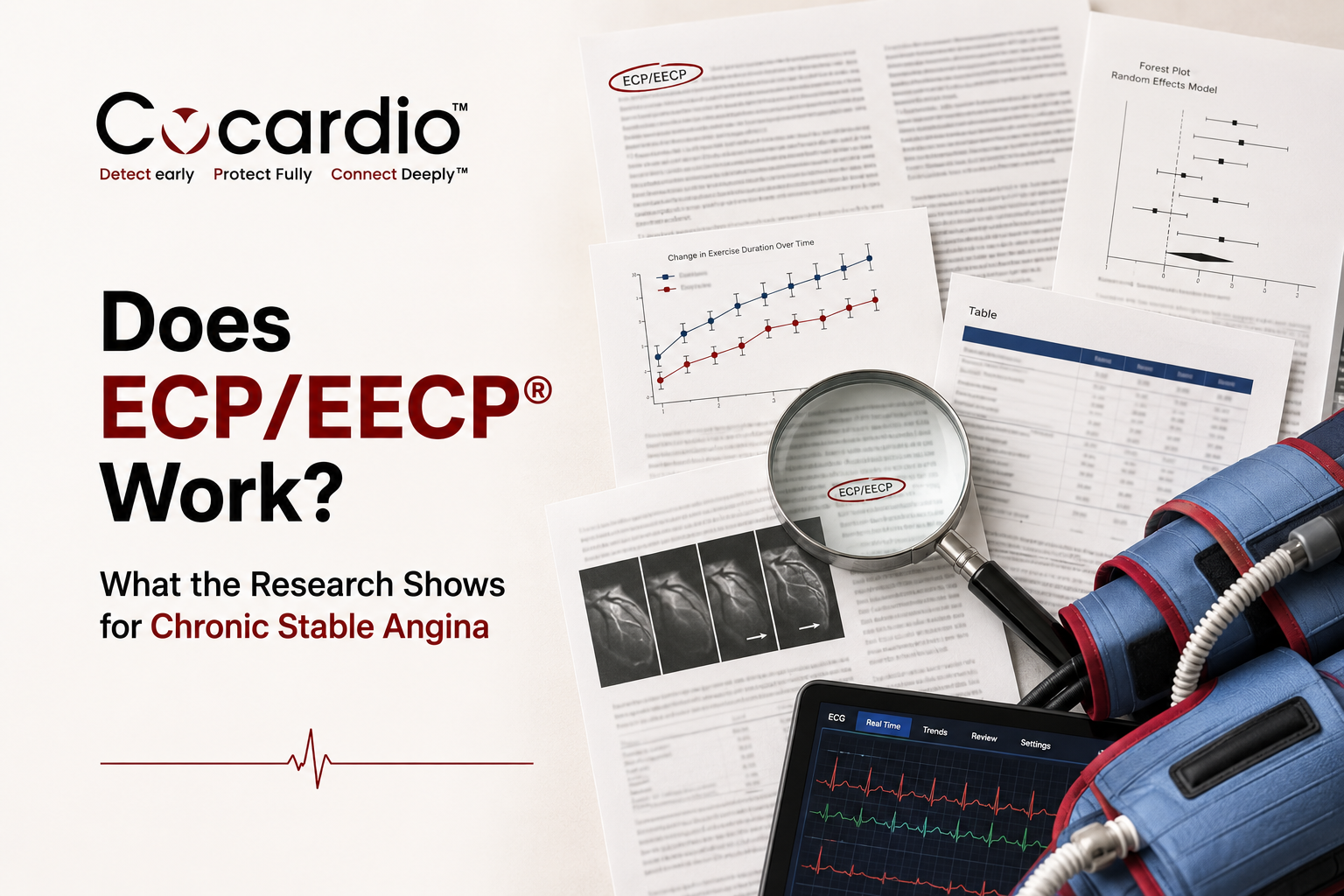
The therapy has been evaluated in randomized trials and large observational registries. In the landmark MUST-EECP trial, active EECP improved time to exercise-induced ischemia compared with sham treatment.
Large registry studies have also reported substantial reductions in angina severity following treatment, with some patients maintaining improvements during longer-term follow-up.
However, these findings should not be interpreted as proof that ECP works for everyone.
The current evidence base has important limitations, including relatively small randomized trials and a reliance on observational registry data for many longer-term findings. The 2023 AHA/ACC chronic coronary disease guideline describes the evidence supporting EECP as limited and places it within the management of refractory angina when other treatment options are unavailable.
So the evidence supports potential symptom benefit in selected patients, not a universal promise
First, a Quick Refresher: What Is ECP/EECP® Therapy?
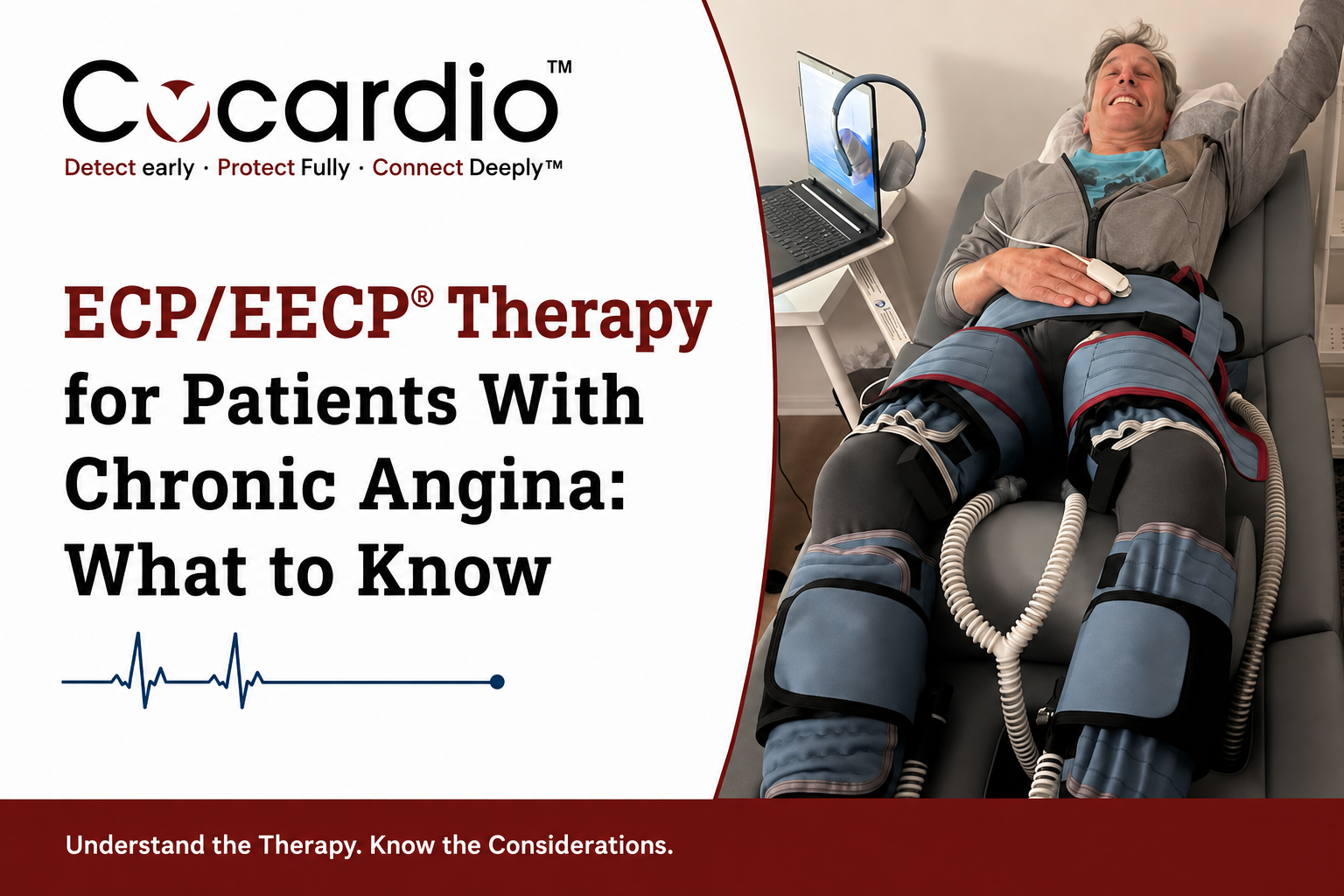
Enhanced External Counterpulsation is a noninvasive therapy in which inflatable cuffs around the calves, thighs, and lower hips inflate and deflate in sequence, timed to your heartbeat by ECG. The therapy is typically delivered as a course of one-hour sessions, commonly 35 sessions over about seven weeks, in an outpatient setting with no incisions, anesthesia, or hospital stay.
Now, to the evidence.
The Landmark Trial: MUST-EECP
The most frequently cited study is the Multicenter Study of Enhanced External Counterpulsation, known as MUST-EECP, published in the Journal of the American College of Cardiology in 1999. It was the first randomized, blinded, controlled trial of the therapy, conducted across seven university hospitals in the United States, and it compared active EECP against a sham (inactive) version of the treatment in 139 randomized patients with chronic stable angina and documented coronary artery disease.
The trial measured objective and symptom-based outcomes, including exercise duration on a treadmill test, time until ECG changes associated with reduced blood flow to the heart muscle appeared, the frequency of angina episodes, and nitroglycerin use. Patients receiving active treatment showed improvement in time to exercise-induced ischemic changes compared with the sham group, alongside symptom-related benefits.
Why does this study matter so much? Because a randomized, sham-controlled design is what separates a therapy’s real effects from placebo effects and wishful thinking. MUST-EECP is the reason ECP/EECP® therapy earned a serious place in the medical conversation about chronic stable angina.
Beyond the Trial: Registry Data From Thousands of Patients
Randomized trials answer “does it work under controlled conditions?” Registries answer “what happens in real-world practice?”
The International EECP Patient Registry, coordinated through the University of Pittsburgh, tracked outcomes in patients treated at centers around the world. In published registry analyses, roughly three out of four patients experienced improvement of at least one angina class after treatment, and more than a third improved by two or more classes, meaning meaningfully fewer symptoms during daily activity. Published reviews of the broader literature similarly describe reduced angina, decreased reliance on nitroglycerin, longer time to exercise-induced ischemia, and improved quality of life among treated patients with symptomatic stable angina.
Registry data has an important caveat: without a comparison group, it cannot prove cause and effect the way a randomized trial can. But when registry findings from thousands of real-world patients point in the same direction as controlled trial results, the overall picture strengthens.
What Guidelines and Regulators Say
ECP/EECP® therapy is cleared by the U.S. Food and Drug Administration for use in chronic stable angina, among other indications. In Europe, cardiology guidance has recognized external counterpulsation as an option that may be considered for symptom relief in patients with refractory angina, meaning angina that persists despite optimal standard treatment, while also calling for further randomized trials to better define its role.
That dual message, recognized as an option and still being studied, is an accurate summary of where the therapy sits in mainstream medicine.
The Honest Limitations
A trustworthy answer to “does it work?” must include what the research has not settled on.
The randomized trials are small. MUST-EECP enrolled 139 patients, which is meaningful but modest by cardiology trial standards, and reviewers have noted methodological limitations, including that key trials received sponsorship from the device manufacturer. Independent, larger randomized trials remain a recognized need.
The mechanism is still being clarified. Interestingly, some studies have found that patients report reduced angina and better exercise tolerance even when measurable changes in blood flow to the heart muscle were not detected, and researchers continue to investigate how the benefits arise, including possible effects on blood vessel function. In other words, many patients report feeling better; the full explanation of why is still an active research question.
Durability and patient selection are open questions. How long reported improvements last, and which patients are most likely to benefit, continue to be studied. Not every patient responds, and no honest provider will promise that you will.
Completion matters. Reviewers have noted that incomplete treatment courses complicate the research picture, which echoes something practical: the therapy is studied and delivered as a full series, not a sample.
None of these limitations erase the positive findings. They frame them. This is a therapy with decades of study, a supportive randomized trial, consistent registry data, and regulatory clearance, and it is also a therapy where science is still refining the details. Both things are true.
What This Means for You
Research describes populations. You are an individual. Whether ECP/EECP® therapy may be appropriate in your case depends on your diagnosis, your current medical care, your health history, and screening for the conditions that make the therapy unsuitable for some people.
That is why, at CoCardio®, we do not begin with a treatment. We begin by understanding you. Every care journey starts with a Root Cause Consultation, where our team reviews your health history, current care, and goals, and determines whether ECP/EECP® therapy, or any element of a personalized plan, may have an appropriate role, always as an adjunct to your cardiac care, complementing, rather than replacing, your cardiologist, medications, and any recommended procedures.
Frequently Asked Questions
Is ECP/EECP® therapy scientifically proven?
It depends on the standard of proof you apply. The therapy is supported by a randomized, sham-controlled trial, large real-world registries, decades of clinical use, and FDA clearance for chronic stable angina. At the same time, researchers continue to call for larger independent trials, and questions about mechanisms and durability remain under study. It is evidence-supported and still being researched, and both parts of that answer are important.
Will ECP/EECP® therapy definitely reduce my angina?
No one can promise that. Many appropriately selected patients in studies and registries reported reduced angina and improved activity tolerance, but individual responses vary, and some patients do not experience meaningful change. Screening, consultation, and realistic expectations come first.
Does ECP/EECP® therapy remove plaque or cure coronary artery disease?
No. The research does not show plaque removal or cure of the underlying disease, and no provider should claim otherwise. The studied benefits relate to symptoms, exercise tolerance, and quality of life in appropriately selected patients.
Can I rely on ECP therapy instead of my medications or a recommended procedure?
No. CoCardio® never advises anyone to stop, reduce, or change prescribed medication, and decisions about procedures belong with your cardiology team. ECP/EECP® therapy is designed to complement, rather than replace, established medical care.
How many sessions did patients in the research complete?
The standard studied course is a series of one-hour sessions, commonly 35 over about seven weeks. Researchers have noted that incomplete courses complicate outcomes, which is one reason consistency and completion are emphasized in practice.
Does insurance cover ECP sessions at CoCardio®?
No. CoCardio® is a cash-pay practice. We do not bill insurance for consultations, ECP sessions, or preventive cardiovascular wellness services. Eligible HSA and FSA payments may be accepted. Patients should confirm eligibility requirements with their individual plan administrator.
An Informed Decision Is the Goal
“Does it work?” deserves the answer the research actually gives: encouraging results for many appropriately selected patients with chronic stable angina, honest limitations, and ongoing study. If that balanced picture resonates with the way you want to make health decisions, we would welcome the conversation.
Your first step is a consultation so we can understand your health history, goals, current care, and whether CoCardio® services may be appropriate as part of your personalized cardiovascular wellness plan.
For your privacy, please do not share personal health information in public comments or unsecured messages. To discuss your individual situation, please contact our office directly through appropriate channels.
References
- Arora RR, Chou TM, Jain D, Fleishman B, Crawford L, McKiernan T, Nesto RW. The multicenter study of enhanced external counterpulsation (MUST-EECP): effect of EECP on exercise-induced myocardial ischemia and anginal episodes. Journal of the American College of Cardiology. 1999;33(7):1833-1840. doi:10.1016/S0735-1097(99)00140-0. PMID: 10362181.
- Barsness G, Feldman AM, Holmes DR Jr, Holubkov R, Kelsey SF, Kennard ED. The International EECP Patient Registry (IEPR): design, methods, baseline characteristics, and acute results. Clinical Cardiology. 2001;24(6):435-442. doi:10.1002/clc.4960240604.
- Soran O, Kennard ED, Kfoury AG, Kelsey SF; IEPR Investigators. Two-year clinical outcomes after enhanced external counterpulsation (EECP) therapy in patients with refractory angina pectoris and left ventricular dysfunction (report from the International EECP Patient Registry). American Journal of Cardiology. 2006;97(1):17-20. doi:10.1016/j.amjcard.2005.07.122. PMID: 16377276.
- Loh PH, Cleland JG, Louis AA, Kennard ED, Cook JF, Caplin JL, Barsness GW, Lawson WE, Soran OZ, Michaels AD. Enhanced external counterpulsation in the treatment of chronic refractory angina: a long-term follow-up outcome from the International Enhanced External Counterpulsation Patient Registry. Clinical Cardiology. 2008;31(4):159-164. doi:10.1002/clc.20117. PMID: 18404725.
- Virani SS, Newby LK, Arnold SV, et al. 2023 AHA/ACC/ACCP/ASPC/NLA/PCNA Guideline for the Management of Patients With Chronic Coronary Disease: A Report of the American Heart Association/American College of Cardiology Joint Committee on Clinical Practice Guidelines. Circulation. 2023;148(9):e9-e119. doi:10.1161/CIR.0000000000001168. PMID: 37471501.
- Manchanda A, Soran O. Enhanced external counterpulsation and future directions: step beyond medical management for patients with angina and heart failure. Journal of the American College of Cardiology. 2007;50(16):1523-1531. doi:10.1016/j.jacc.2007.07.024. PMID: 17936150.
- Braith RW, Casey DP, Beck DT. Enhanced external counterpulsation for ischemic heart disease: a look behind the curtain. Exercise and Sport Sciences Reviews. 2012;40(3):145-152. doi:10.1097/JES.0b013e318253de5e.
- Michaels AD, Barsness GW, Soran O, Kelsey SF, Kennard ED, Hui JC, Lawson WE; International EECP Patient Registry Investigators. Frequency and efficacy of repeat enhanced external counterpulsation for stable angina pectoris (from the International EECP Patient Registry). American Journal of Cardiology. 2005;95(3):394-397. doi:10.1016/j.amjcard.2004.09.041.
This article is provided for general educational purposes and does not constitute medical advice, diagnosis, or treatment. Individual circumstances vary, and decisions regarding cardiovascular care should be made with appropriate healthcare professionals.
CoCardio® services are designed to complement, not replace, emergency care, a cardiologist, primary care physician, cardiac rehabilitation program, prescribed medication, diagnostic testing, or medically recommended procedures.
If you have new, severe, or worsening symptoms, seek appropriate medical attention rather than relying on information provided in this article.
EECP® is a registered trademark of Vasomedical Inc., NY.